Step 3: Property Valuation & Final Mortgage Approval
This is the quiet stage. You have your pre-approval, you have signed Form F, and you have paid your 10% deposit. Nothing seems to be happening. The bank has gone silent for a week or two. And then the valuation report arrives and everything either falls into place or falls apart.
TL;DR
- The valuation is done by a DLD-approved independent valuer appointed by the lender not by you, the seller, or the agent.
- Typical valuation cost: AED 2,500 – 3,500. Turnaround: 3–5 working days.
- If the valuation comes in below your agreed price, the bank lends only against the lower figure you cover the shortfall in cash, renegotiate, or walk away.
- The Mortgage Offer Letter (MOL) is your binding contract. Verify every term before you sign especially insurance, salary transfer, and early settlement.
- Property + life insurance are mandatory for the life of the mortgage. Total annual cost typically AED 3,000–8,000.
- Do not take new loans, miss payments, or change jobs between pre-approval and drawdown. Any of these can revoke your final approval.
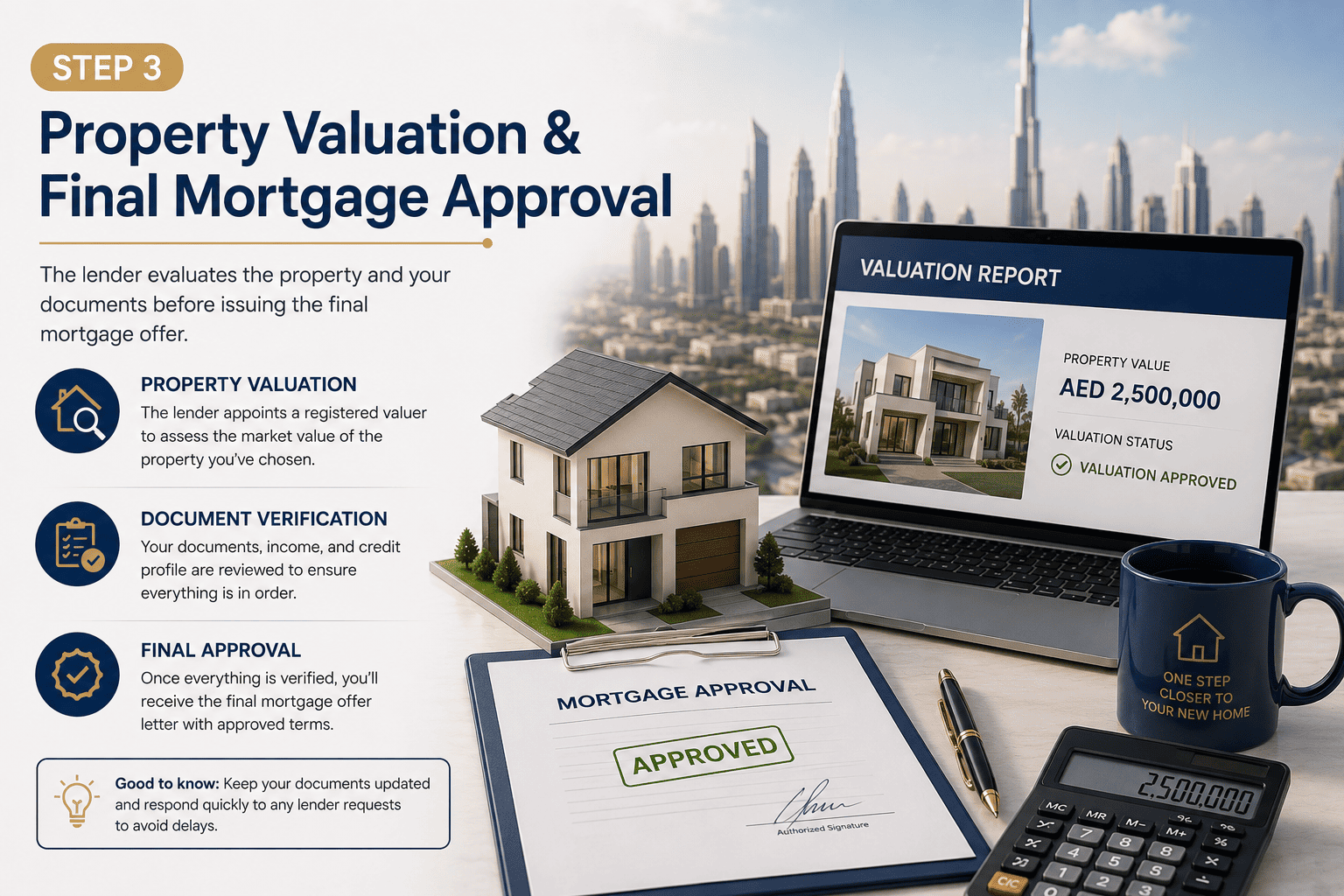
Step 3 is where lenders convert your pre-approval into a legally binding offer. Two things need to happen: the property has to value up to the agreed price (or close to it), and your personal finances have to have stayed exactly as they were when you were pre-approved. If either fails, you can lose the deal.
This guide covers the valuation process end-to-end, what to do if the value comes in low, how to read and challenge the Mortgage Offer Letter, insurance requirements, and crucially the specific financial moves that can undo everything you have built to this point.
What Happens Between Pre-Approval and Final Approval
Pre-approval is a lending intention. Final approval is a binding commitment. Between the two, three things happen in parallel:
- The bank re-verifies your finances updated bank statements, current salary, credit history, and any new debts you may have taken on since pre-approval.
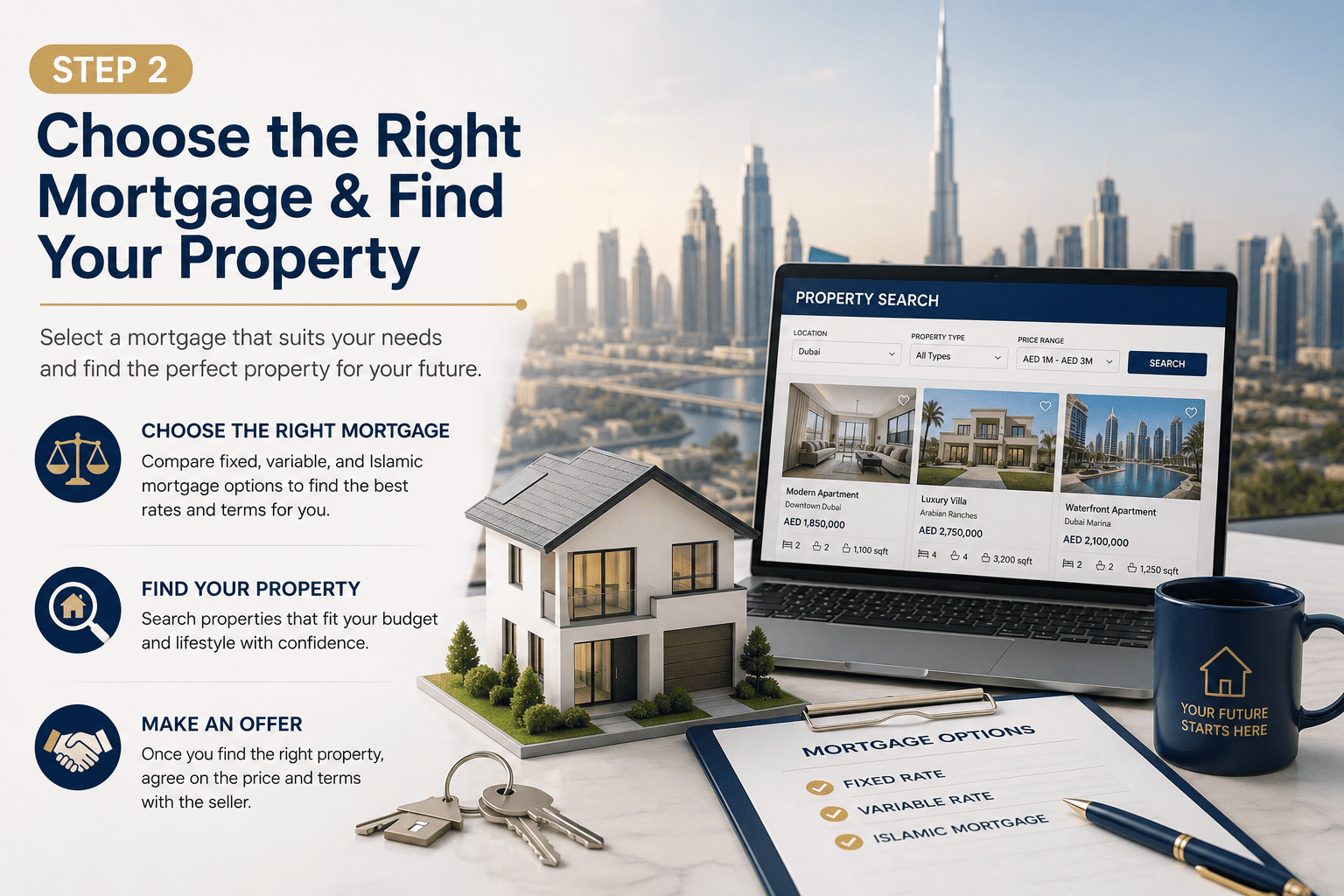
- The property is valued an independent valuer inspects the property and provides the bank with a written market value estimate.
- The property is legally checked the bank confirms clear title, no encumbrances, and (for secondary sales) the seller's ability to transfer.
If all three come back clean and the numbers work, the bank issues the Mortgage Offer Letter your final approval. Timing is typically 1 to 3 weeks from Form F signing.
The Property Valuation Process
Who Appoints the Valuer
The valuer is appointed by the lender, from its approved panel. In Dubai, all mortgage valuations must be conducted by valuers registered with the Dubai Land Department (DLD). Similar accreditation requirements apply in Abu Dhabi (Department of Municipalities and Transport) and other emirates.
You pay the valuation fee but you do not choose the valuer. This is important, because it means the valuer has no incentive to please you or the seller. Their job is to give the bank an independent, defensible view of what the property is worth.
What the Valuer Actually Inspects
A typical property valuation visit takes 30–60 minutes. The valuer will:
- Physically inspect the property every room, all fixtures, finishes, and appliances included in the sale
- Verify actual square footage against the title deed and floor plan
- Note the age of the building, layout, view, floor level, and any premium features
- Check for obvious defects water damage, structural cracks, poor maintenance, incomplete finishes
- Verify community amenities, parking, and common areas
- Take photos for the report
They then return to their office and produce a written report comparing the property against:
- Recent transactions in the same building or community (within the last 3–6 months)
- Current active listings for comparable units
- Market trends for the specific community and property type
- Any adjustments for condition, view, floor, or included furnishings
How Long It Takes and What It Costs
Valuation fees are typically AED 2,500 to AED 3,500, paid by the buyer to the valuer's firm (sometimes routed through the bank). Villa and townhouse valuations may cost slightly more than apartment valuations because of the physical scope of inspection.
Turnaround time is usually 3 to 5 working days from the valuer's site visit to the report reaching the bank. Delays can occur if the valuer needs additional access, further comparables, or if the property has unusual features requiring specialist input.
What the Valuation Report Contains
The valuation report submitted to your lender includes:
- Market value estimates the single number that matters most. This is what the bank uses to size your loan.
- Property description plot/unit number, community, floor level, layout, size, key features.
- Comparable transactions three to five recent sales in the area, forming the basis of the valuer's opinion.
- Photos condition documentation.
- Red flags noted any structural issues, incomplete finishes, service charge disputes, or title concerns.
- Forced sale value the estimated resale value within a 90-day window, typically 10%–15% below open-market value.
What to Do If the Valuation Comes In Low
This is one of the most common and most stressful moments in the UAE mortgage process. It happens frequently in fast-moving markets, where buyers agree prices with sellers based on recent momentum, but valuers rely on completed transactions from 3–6 months earlier.
You have four practical options:
Option 1: Renegotiate the Purchase Price
The most common outcome. Present the valuation report to the seller (through your agent) and ask them to reduce the purchase price to match. Reasonable sellers, especially those who need to complete the sale, will often accept a partial or full reduction because if you walk away, they face the same valuation issue with the next buyer.
Option 2: Cover the Shortfall in Cash
If the seller refuses to renegotiate and you still want the property, you can increase your down payment to close the gap. Example: agreed price AED 1.5M, valuation comes in at AED 1.4M. The bank will lend 80% of AED 1.4M = AED 1.12M. You now need AED 380K in cash (up from AED 300K) plus your other transaction costs.
Option 3: Request a Revaluation
If you believe the valuation is materially inaccurate perhaps the valuer used the wrong comparables, missed a recent transaction, or didn't account for premium features you can request a revaluation. This typically means paying for a second valuation from a different valuer on the bank's panel. If the second valuation is meaningfully higher, most banks will use it or average the two.
Option 4: Walk Away
The most costly option. If Form F was signed without a financing condition and you fail to complete, you typically lose your 10% deposit. Only viable if the price gap is large enough to make the deposit loss worthwhile.
Practical tip: Before you sign Form F, ask your agent for the last 3–6 months of transaction data in the same building or community. This gives you a realistic view of what the valuer is likely to see. If your agreed price is more than 5%–8% above recent transactions, you should expect valuation friction.
Disputing a Valuation Report
If you believe the valuation report contains factual errors wrong square footage, missing features, incorrect comparables, or overlooked recent transactions you have the right to raise a dispute with the bank. The process:
- Request the full valuation report from the bank (they are not always automatically shared).
- Identify specific factual errors or missed comparables vague disagreement is unlikely to succeed.
- Submit a written dispute to the bank with your supporting evidence: transaction data, correct floor plan, photos, or a professional second opinion.
- Request a revaluation from a different panel valuer if the dispute is accepted. Expect to pay for the second valuation.
Disputes based on genuine errors have a reasonable success rate. Disputes based purely on "the number feels too low" almost never succeed, because the valuer's methodology is designed to reflect the market, not the buyer's optimism.
The Mortgage Offer Letter What to Check
Once the valuation comes back and re-verification is complete, the bank issues the Mortgage Offer Letter (MOL) sometimes called the Final Offer Letter or Facility Offer Letter. This is a binding document. Read it carefully before signing.
The 10 terms that matter most:
|
Term to verify |
What to check for |
|
Loan amount |
Must match your agreed purchase price minus your down payment. Watch for rounding errors. |
|
Interest / profit rate |
Exact rate, fixed period, revert rate after fixed period ends. Confirm whether Islamic profit rate or conventional interest. |
|
Tenure |
Maximum 25 years residential (CBUAE cap). Confirm end date does not exceed your age-at-maturity limit. |
|
Monthly payment (EMI) |
Calculated at the offered rate. Verify the number matches independently use any mortgage calculator. |
|
Processing fee |
Typically 0.5%–1% of loan amount. Confirm cap (usually AED 12,000–15,000) and whether it can be added to loan or must be paid upfront. |
|
Salary transfer |
Required or optional. If required, note the minimum lock-in period and rate impact if you break it. |
|
Insurance requirements |
Property + life insurance. Confirm whether provider is bank-preferred, mandatory, or freely chosen. |
|
Early settlement fee |
Maximum 1% of outstanding balance or AED 10,000, whichever is lower CBUAE cap. Anything higher is not compliant. |
|
Rate lock validity |
How long the offered rate stays valid. Typically, 60–90 days from the offer letter date. |
|
Conditions precedent |
Any final steps you must complete before drawdown updated documents, insurance certificates, valuation report received, etc. |
Reality check: The Mortgage Offer Letter should exactly match what your pre-approval promised or be better. If any term has quietly worsened a higher rate, a shorter fixed period, an added condition question it immediately. Banks sometimes tighten terms between pre-approval and MOL if their internal rates have moved, but you have the right to negotiate or walk.
Insurance Requirements
UAE lenders require two insurance policies for the life of the mortgage property insurance and life insurance. Both must name the bank as the beneficiary (called 'assignment') so that in the event of a claim, the bank is repaid first.
Property Insurance
Property insurance covers physical damage to the structure and (usually) contents. It is mandatory during the mortgage term. Typical annual cost: AED 1,500 to AED 3,000 for an apartment; AED 2,500 to AED 5,000 for a villa. Cost varies by property value, location, and coverage level.
Some banks require you to buy property insurance through their preferred provider (potentially more expensive). Others allow you to choose any UAE-licensed insurer, provided the policy meets minimum coverage requirements. Always ask which applies to your offer.
Life Insurance
Life insurance covers the outstanding mortgage balance in the event of death or (in some policies) total permanent disability. Typical structure is decreasing term life the cover amount reduces as your mortgage balance reduces. Annual cost: AED 1,500 to AED 5,000, depending on your age, health, mortgage amount, and lender.
Life insurance is universally mandatory for UAE mortgages. Some banks bundle it with the mortgage (convenient but often more expensive), others require you to source it externally and assign to the bank.
Insurance tip: Insurance premiums can add 1%–2% to the effective cost of your mortgage over the term. If your bank allows you to shop for external providers, do so. A broker can quickly compare life and property insurance across licensed UAE providers, and the savings often add up to AED 10,000–20,000 over 25 years.
Financial Moves That Can Revoke Your Final Approval
Between pre-approval and drawdown, your bank re-checks your finances at least once more often twice. Any material change can undo the approval. These are the specific mistakes that regularly kill deals at this stage:
- Taking on a new loan a car loan, personal loan, or another mortgage application will show up on your AECB report and can push your DBR above 50%. Wait until after drawdown.
- Missing loan or credit card payments a single missed payment on any UAE credit facility can trigger a hard re-underwrite. Set every payment on auto-debit.
- Cheque bounces a returned cheque during this window is one of the fastest ways to lose approval. Some lenders also treat historical bounces as sufficient reason to withdraw.
- Increasing credit card balances maxing out a card in this window signals financial stress and increases your DBR. Keep utilisation below 30%.
- Changing jobs even a promotion within the same company can trigger a fresh probation clock at the new role. If a change is unavoidable, tell your lender immediately.
- Salary drop or bonus reversal a lower salary in the most recent pay slip can trigger a re-verification. If your income structure includes variable components, keep supporting documentation ready.
- Withdrawing your down payment the bank will verify the funds are still available at drawdown. Keep the down payment liquid and untouched in the account from pre-approval through transfer.
- Applying for other major credit a new credit card, a car finance quote, or another mortgage application will show up in your AECB report as a "hard search" and raise flags.
The rule to remember: Between pre-approval and drawdown, your financial profile must look exactly the way it did when the bank first approved you or better. Nothing worse. Nothing more complicated. Nothing new.
Frequently Asked Questions
Who pays for the property valuation buyer or bank?
The buyer pays the valuation fee but does not choose the valuer. The bank appoints an independent, DLD-approved valuer from its panel; the buyer pays directly (or through the bank). Typical cost is AED 2,500–3,500. The valuer's report is submitted to the bank, and buyers are often required to request the report separately if they want to see it.
Can I dispute a low property valuation?
Yes, but only on the basis of specific factual errors incorrect square footage, missed recent transactions, wrong comparables, or overlooked features. Vague disagreement based on "the number feels too low" almost never succeeds. If your dispute is accepted, you can request a revaluation from a different panel valuer, typically at your own cost. If the second valuation is meaningfully higher, most banks will use it or average the two.
How long does final mortgage approval take after pre-approval?
Typically, 1 to 3 weeks from the date you sign Form F, assuming the valuation goes smoothly and your finances remain stable. The main variables are valuation turnaround (3–5 working days), bank re-underwriting (5–10 working days), and any conditions the bank may impose. Complex or non-standard properties, off-plan purchases, and non-resident buyer profiles take longer.
Is life insurance mandatory for a UAE mortgage?
Yes. Every UAE lender requires life insurance covering the outstanding mortgage balance for the life of the loan. Property insurance is also mandatory. Typical combined annual cost: AED 3,000 to AED 8,000, depending on the property, borrower profile, and provider. Both policies must name the bank as the assigned beneficiary.
Can I choose my own property insurance provider?
It depends on the lender. Some UAE banks require you to buy insurance through their preferred (in-house or partnered) provider. Others allow you to buy from any UAE-licensed insurer, provided the policy meets minimum coverage requirements and the bank is assigned as the beneficiary. Always ask about this before signing the Mortgage Offer Letter the difference in premium between bundled and freely-chosen policies can be significant.
What happens if my final approval is rejected after pre-approval?
If your final approval is denied, the deal is at risk. You have a few options: appeal to the bank with additional documentation or explanation; apply to another lender using the same pre-verified profile (a broker can accelerate this); renegotiate with the seller for more time; or walk away, potentially losing your 10% Form F deposit. The most common causes of post-pre-approval rejection are: valuation coming in significantly low, material changes in your finances (new debt, missed payments, job change), or newly discovered information on the AECB report.
Worried About Your Valuation or Final Approval?
The gap between pre-approval and drawdown is where the most deals collapse and where good advice pays for itself many times over. Getting a second opinion on your valuation, understanding your Mortgage Offer Letter properly, or comparing insurance costs across providers can save you tens of thousands of dirhams over the mortgage term.
At ClearRate, we work alongside your lender through this stage reviewing your MOL, flagging any terms that changed from pre-approval, and connecting you to competitive insurance quotes if your bank allows external providers. There's no fee to you we're compensated by the lender when your mortgage completes.
💬 Chat with a mortgage expert on WhatsApp instant response during UAE business hours
📞 Call us on +971 X XXX XXXX
🧮 Review your mortgage offer with an expert
Mortgage Offer Letter signed. What next?
→ Read Step 4: Property Transfer, Handover & Becoming a Homeowner
Disclaimer: Valuation fees, insurance costs, mortgage terms, and lender processes vary and change over time. All figures accurate to the best of our knowledge as of April 2026 and based on Central Bank of the UAE Circular 31/2013 (as amended) and Dubai Land Department valuation guidelines where relevant. This guide is general information and does not constitute financial or legal advice. Always confirm current requirements with your lender or a qualified UAE mortgage adviser before making a decision. ClearRate is a UAE-licensed mortgage brokerage.