Step 1: Check Your Mortgage Eligibility & Get Pre-Approval
The single biggest mistake I see UAE property buyers make is falling in love with a property before knowing what they can actually borrow. Two weeks of house-hunting, an offer accepted, a broker introduction, then the bank comes back with a lower number than expected and the whole deal has to be renegotiated or abandoned.
TL;DR
- The UAE Central Bank caps your total monthly debt at 50% of gross income the Debt Burden Ratio (DBR).
- Expat residents can borrow up to 80% LTV, UAE nationals 85%, non-residents 50–65%.
- Most banks require minimum monthly salary of AED 15,000–25,000 for expats; AED 8,000–15,000 for UAE nationals.
- A clean 12-month AECB credit record is critical. Recent cheque bounces, missed payments, or maxed-out cards will hurt your application.
- Pre-approval is free, typically issued within 3–10 working days, and valid for 60–90 days.
- Get pre-approved before viewing properties. It defines your real budget and strengthens your negotiating position with sellers.
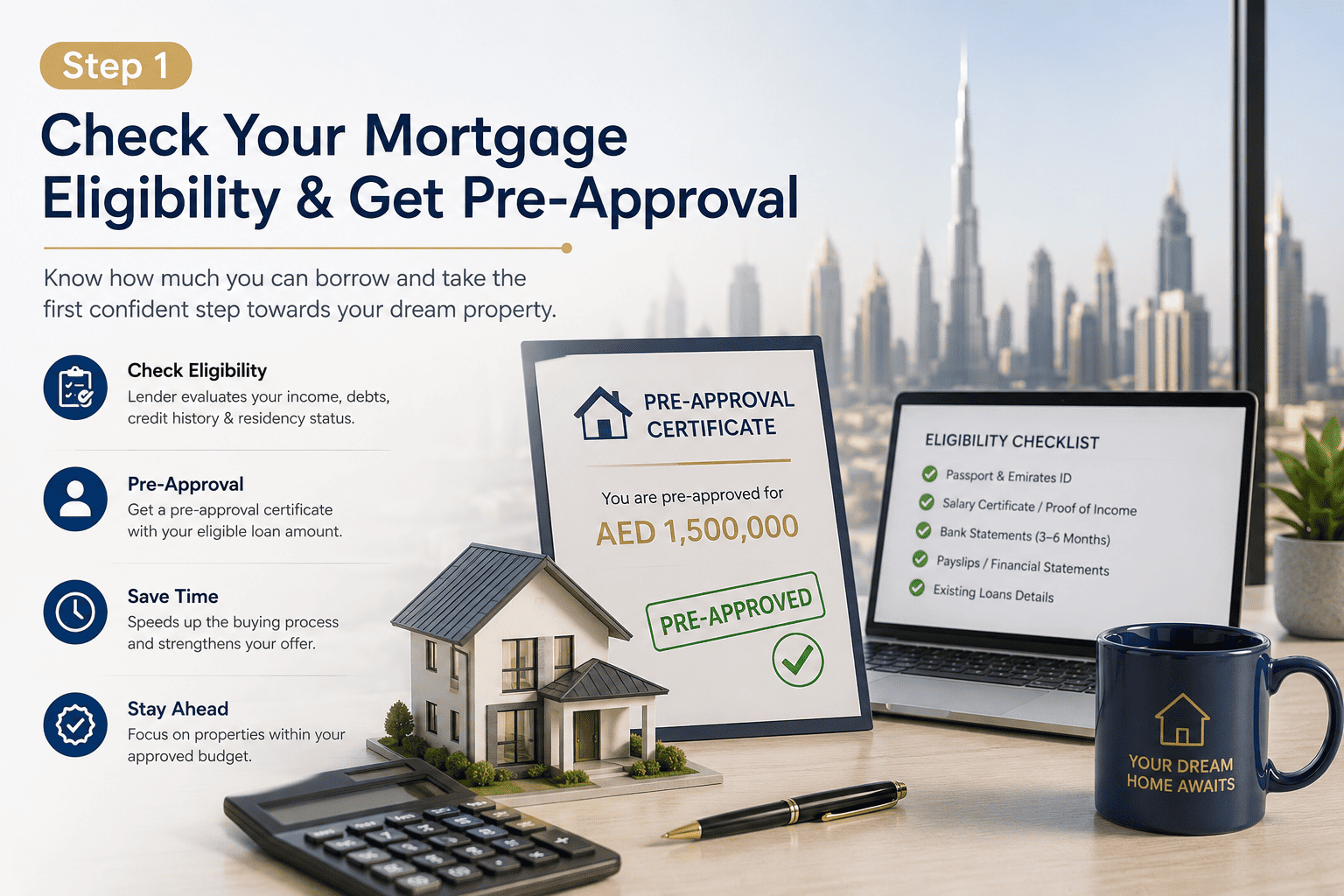
Pre-approval prevents that. It's a conditional lending indication from a UAE bank that tells you, in writing, how much you can borrow at what rate, based on a full review of your income, credit history and existing commitments. It's not a guarantee the property still needs to value up and pass final checks, but it turns your search from guesswork into precision.
This guide walks you through the three financial tests every UAE lender runs, the documents you'll need, and how to avoid the eligibility mistakes that cause most pre-approval rejections. All figures are based on Central Bank of the UAE Circular 31/2013 (as amended) the regulation that governs UAE residential mortgages.
Who Can Get a Mortgage in the UAE?
Under CBUAE Circular 31/2013, three categories of buyers can access residential mortgages:
- UAE Nationals highest LTV, lowest thresholds, widest lender access.
- Expat residents with a valid UAE residence visa the majority of the market. Employed in the UAE with salary paid into a UAE bank account.
- Non-residents foreign nationals living outside the UAE, buying property in designated freehold zones. LTV is capped lower and requirements are stricter.
Your residency status directly determines how much you can borrow:
- UAE National: up to 85% LTV (1st property under AED 5M), 75% (over AED 5M), 65% (2nd or investment property).
- Expat resident: up to 80% LTV (1st property under AED 5M), 70% (over AED 5M), 60% (2nd or investment property).
- Non-resident: 50–65% LTV, depending on the lender.
- Off-plan property (any buyer): 50% LTV maximum.
Age at maturity: Most UAE lenders require the mortgage to be fully repaid by age 65 (salaried expats) or 70 (UAE nationals and self-employed borrowers). If you're 55 and want a 25-year mortgage, you'll be capped at a shorter term.
The 3 Financial Tests Every UAE Lender Runs
Before issuing a pre-approval, every UAE bank runs your profile through three parallel checks. Understanding what they measure and where the pass thresholds sit is the difference between a smooth approval and a rejection you don't understand.
Test 1: Debt Burden Ratio (DBR)
The DBR is the most important number in your application. It measures what percentage of your gross monthly income is already committed to debt payments credit cards, personal loans, car loans, existing mortgages, education loans, and any other regular repayments.
The Central Bank of the UAE caps DBR at 50% of gross monthly income. Your total commitments after the new mortgage existing debt plus the new mortgage payment cannot cross that ceiling.
WORKED EXAMPLE DBR CALCULATION
Gross monthly salary: AED 25,000
Existing monthly commitments:
• Credit card minimum payment: AED 2,000
• Personal loan repayment: AED 3,500
• Car loan payment: AED 2,500
Total existing commitments: AED 8,000
CBUAE cap (50% of AED 25,000): AED 12,500
Available for mortgage payment: AED 12,500 − AED 8,000 = AED 4,500/month
Current DBR: 8,000 ÷ 25,000 = 32% (below the 50% ceiling approved for further borrowing).
An AED 4,500 monthly capacity translates into a mortgage of roughly AED 750,000 to AED 900,000 over 25 years, depending on the interest rate. If your existing commitments are already at AED 12,000 per month, your available mortgage capacity would only be AED 500 effectively closing the door on any meaningful borrowing until you reduce those commitments.
Practical tip: If your DBR is close to the ceiling, pay down credit cards and small personal loans in the 3–6 months before applying. It is the single most effective way to increase your borrowing capacity, and it costs you nothing but a bit of time.
Test 2: Income & Employment Stability
Lenders want to see stable, verifiable income from a source that will continue. This affects both your eligibility and the rate you're offered.
- Salaried employees: most banks require a minimum of 6 months in your current role (some banks: 3 months if you've been in the same industry for 2+ years). You'll be asked for a salary certificate and pay slips.
- Self-employed: your company should have a trade license active for at least 2 years, and you'll need audited financials and 6–12 months of business bank statements.
- Probation period: applications are usually declined during probation. Wait until you have been confirmed in your role.
- Employer type: banks maintain internal lists of 'listed' and 'non-listed' employers. Employees of listed employers (major UAE corporations, government, healthcare, aviation, banking) typically get better rates and higher approval odds.
Test 3: Credit History (AECB Report)
Every UAE lender pulls your credit report from the Al Etihad Credit Bureau (AECB) the country's central credit registry. Your AECB score (300–900) reflects your repayment history across all UAE credit facilities.
A score above 700 is considered strong. Below 600 will trigger tougher scrutiny or outright rejection at most banks.
What the AECB report shows:
- Every credit card, loan and mortgage in your name
- Repayment history for the last 24 months
- Any missed payments, defaults, or written-off accounts
- Any cheques returned unpaid
- Any court judgments related to debt
You can pull your own AECB report for around AED 84 via the AECB app before you apply. Do this it lets you spot and challenge errors before they cost you a mortgage approval. If you find outdated information (a settled loan still showing as active, for example), you have the right to dispute it directly with the AECB.
Minimum Salary Requirements
Salary thresholds vary by lender, applicant type, and target property. Here are the typical minimums across the UAE market:
|
Applicant type |
Typical minimum gross monthly income |
Notes |
|
UAE National |
AED 8,000 – 15,000 |
Lower thresholds available at national-focused banks |
|
Expat resident (salaried) |
AED 15,000 – 25,000 |
Most common category |
|
Expat resident (self-employed) |
AED 25,000 – 50,000 |
Bank sets threshold based on business type |
|
Non-resident |
AED 30,000+ equivalent |
Case-by-case; limited to freehold zones |
These are minimums. Higher-value purchases naturally require higher incomes a lender may accept a AED 15,000 salary for an AED 800,000 apartment but not for a AED 3 million villa.
Documents You'll Need for Pre-Approval
Preparation matters. Assemble these documents before you approach a lender or broker pre-approvals typically stall for 5–10 days waiting for missing paperwork.
If you are salaried
- Emirates ID (both sides)
- Passport with valid residence visa page
- Recent salary certificate (issued in the last 30 days, addressed to the bank)
- Latest 3–6 months' pay slips
- Latest 6 months' personal bank statements (all accounts)
- Latest utility bill or DEWA/tenancy contract as address proof
- If you have existing loans: latest statements showing outstanding balance and monthly payment
If you are self-employed or a business owner
- Emirates ID, passport, visa page
- Trade license (active for at least 2 years)
- Memorandum of Association / commercial registration
- Audited financial statements for the last 2 years
- Latest 6–12 months' company bank statements
- Latest 6 months' personal bank statements
- Chamber of Commerce certificate (where applicable)
- Details of any existing borrowing (personal or business)
If you are a non-resident buyer
- Passport (all pages)
- Overseas proof of income salary certificate or employment contract
- Latest 6–12 months' overseas bank statements
- Overseas credit report (if available in your country of residence)
- CV / employment history summary
- Property details of the UAE property you intend to purchase
Non-resident note: Non-resident applications go through a specialist team at each participating bank and typically take longer plan for 2–4 weeks to pre-approval rather than the 3–10 days a resident might expect. Not every UAE bank accepts non-resident applications.
How to Get Pre-Approved (The Step-by-Step Process)
Once your documents are ready:
- Compare lenders first either through a mortgage broker (recommended, no cost to you) or by approaching banks directly. A broker gives you access to 8–12 lender offers in a single conversation.
- Submit your application with a complete document pack. Missing documents are the single biggest cause of pre-approval delays.
- Underwriting reviews the lender's credit team reviews your DBR, AECB report, employment stability, and total exposure. Expect follow-up questions.
- Pre-approval issued in writing this is called an in-principal approval or pre-approval letter. It confirms the maximum loan amount, indicative rate, tenure, and any conditions.
- Use the letter to negotiate sellers and agents take pre-approved buyers more seriously. In fast-moving markets, it's often the difference between winning and losing a property.
Common Reasons for Pre-Approval Rejection
Nine out of ten pre-approval rejections come down to one of these issues:
- Existing debt too high (DBR near or above 50%) the most common single cause. Fix by paying down credit cards and unsecured loans before applying.
- Poor AECB credit history cheque returns, missed payments, or written-off debts on the last 12 months' record.
- Employment probation or recent job change most lenders won't consider an application in the first 3–6 months of a new role.
- Insufficient income for the target property the math simply does not work at the requested loan size.
- Incomplete or inconsistent documents mismatched addresses across documents, expired trade licenses, missing pay slips.
- Salary transfer conflict some banks require your salary to be transferred to them for their best rates. If you are locked into a different bank via an existing loan, this can block certain offers.
- Unclear source of down payment banks may ask you to show where the 20% (or more) is coming from. Recently received large gifts or overseas transfers can require additional documentation.
If you are rejected: It's not the end of the road. A rejection at one lender often reflects that lender's specific policy, not your overall creditworthiness. A broker can identify which banks are most likely to approve your specific profile and re-position the application accordingly.
How Long Is Pre-Approval Valid?
Pre-approval letters are typically valid for 60 to 90 days, depending on the lender. If you don't find a property in that window, most lenders will re-issue on request without a full re-underwriting assuming nothing material has changed in your finances.
What can invalidate your pre-approval before expiry: taking on new debt, changing jobs, salary reduction, or a material drop in your AECB score. Keep your finances stable between pre-approval and final approval even small changes can trigger a re-review.
Frequently Asked Questions
What is the maximum DBR allowed by the UAE Central Bank?
The Central Bank of the UAE caps the Debt Burden Ratio at 50% of your gross monthly income. This includes all monthly commitments credit cards, personal loans, car loans, existing mortgages plus the new mortgage payment. Any individual lender may apply a stricter internal cap, but no UAE bank can exceed the 50% CBUAE ceiling.
How long is a UAE mortgage pre-approval valid?
Most UAE lenders issue pre-approval letters valid for 60 to 90 days. If your finances remain stable, most lenders will re-issue at no cost when the initial letter expires. If your income, employment or debt commitments change materially, you may need to reapply from scratch.
Can self-employed applicants get a mortgage in the UAE?
Yes. Self-employed applicants business owners, freelancers with a trade license, and professionals are actively served by UAE lenders, though the process is more document-heavy. Expect to provide 2 years of audited financials, 6–12 months of company bank statements, and a valid trade license. Minimum income thresholds are typically higher (AED 25,000–50,000 monthly) than for salaried applicants.
Do I need a UAE credit history to qualify?
For most UAE lenders, yes at least 6 to 12 months of activity on the Al Etihad Credit Bureau (AECB) is expected. This can come from a UAE credit card, personal loan, telecoms or utility account. Non-residents applying for a mortgage in freehold zones are assessed differently and can qualify based on their overseas credit history and income.
What documents does a non-resident buyer need?
Non-resident buyers typically provide passport (all pages), overseas proof of income and employment, 6–12 months of overseas bank statements, an overseas credit report where available, and details of the UAE property being purchased. Non-resident applications go through specialist lending teams and generally take 2–4 weeks rather than the standard 3–10 days for residents. Not every UAE bank accepts non-resident applications.
Does changing jobs during the application affect approval?
Yes, and it can be fatal to the application. Most lenders require you to have been in your current role for at least 6 months, and any job change during the underwriting process even a promotion will typically trigger a re-underwrite from scratch. If you're planning a career move, either wait until after your mortgage is fully drawn down or complete the mortgage before the move. Don't attempt both in parallel.
Ready to Check Your Eligibility?
Every mortgage application looks different. Your income structure, existing commitments, credit history, and target property all shape which UAE lender is the right match and which product will actually get approved.
At ClearRate, we run your profile against every major UAE mortgage lender in a single conversation, and tell you honestly what you can borrow, at what rate, from which bank. There's no fee to you we're compensated by the lender when your mortgage completes.
💬 Chat with a mortgage expert on WhatsApp instant response during UAE business hours
📞 Call us on +971 X XXX XXXX
🧮 Get a free eligibility check
You are pre-approved. What next?
→ Read Step 2: Choose the Right Mortgage & Find Your Property
Disclaimer: All regulatory figures in this guide (DBR ceiling, LTV caps, tenure limits) are based on Central Bank of the UAE Circular 31/2013 (as amended). Salary thresholds and lender-specific requirements vary and change over time; all figures accurate to the best of our knowledge as of April 2026. This guide is general information and does not constitute financial or legal advice. Always confirm current requirements with your lender or a qualified UAE mortgage adviser before making a decision. ClearRate is a UAE-licensed mortgage brokerage.