How to Get a Mortgage in the UAE: The 2026 Step-by-Step Guide
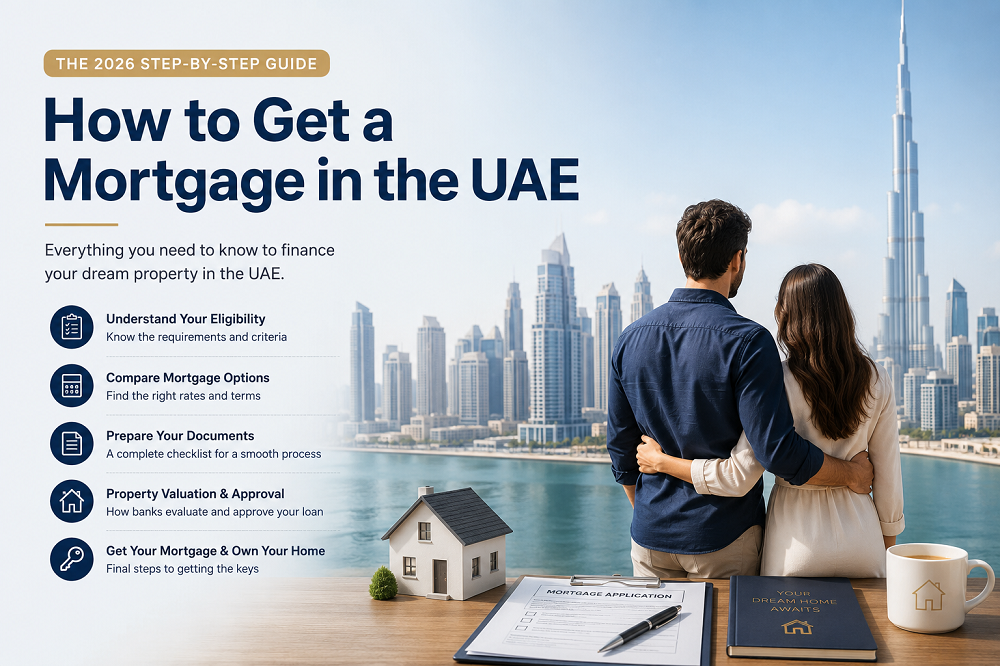
Buying a property in the UAE is easier when you understand the mortgage process from the start. This comprehensive 2026 guide walks you through every stage, from checking your eligibility and comparing lenders to preparing documents, securing pre-approval, property valuation, final approval, and receiving your home loan. Whether you're a UAE resident, expatriate, or non-resident investor, you'll gain practical insights to make informed decisions and confidently finance your dream property.
TL;DR
- The UAE mortgage journey takes 4 to 8 weeks end-to-end and breaks into four clear stages.
- Expat residents can borrow up to 80% LTV, UAE nationals up to 85%, non-residents up to 65% per CBUAE Circular 31/2013.
- The Central Bank caps your total monthly debt commitments at 50% of gross income (DBR).
- Budget for 6–7% of the property price in upfront fees on top of your down payment.
- Get pre-approved before you view properties. It saves weeks and strengthens your negotiating position.
- A property purchase of AED 2 million+ can qualify you for the Golden Visa, even with a mortgage.
Most UAE property buyers I work with don't get into trouble because they can't afford a home. They get into trouble because they underestimated the cash they'd need at closing or fell in love with a property that valued below its asking price or took out a car loan two weeks before completion and watched their mortgage approval evaporate.
Those are the kinds of mistakes this guide is designed to prevent.
The UAE mortgage market is well-regulated by the Central Bank of the UAE (CBUAE) and the process is more straightforward than in most Western markets, but it has its own rules, its own fees, and its own timing quirks. Whether you're a first-time buyer in Dubai Marina, an experienced investor picking up a townhouse in Al Furjan, or a non-resident buying into a Palm Jumeirah project from overseas, understanding the four-stage journey before you begin will save you time, money and unnecessary stress.
At ClearRate, we've helped hundreds of UAE buyers navigate this process, working with every major UAE mortgage lender across Dubai, Abu Dhabi, Sharjah and the Northern Emirates. This series walks through each stage pre-approval, mortgage selection, valuation, and property transfer with the specific numbers, fees, and regulatory limits you actually need to plan properly.
The 4-Step UAE Mortgage Journey at a Glance
|
Stage |
What happens |
Typical timeline |
|
Step 1 Eligibility & pre-approval |
Confirm you meet CBUAE lending rules; get a lender's initial borrowing indication. |
3–10 working days |
|
Step 2 Mortgage & property |
Compare fixed vs variable vs Islamic; agree a purchase price; sign the initial contract (Form F in Dubai). |
1–8 weeks |
|
Step 3 Valuation & final approval |
Bank arranges valuation; issues the Mortgage Offer Letter. |
1–3 weeks |
|
Step 4 Transfer & handover |
Complete the transfer at the DLD Trustee Office; register the mortgage; collect keys. |
1–5 working days |
Realistically, expect 4 to 8 weeks from pre-approval to key handover for a straightforward secondary-market purchase. Off-plan and complex transactions can take longer.
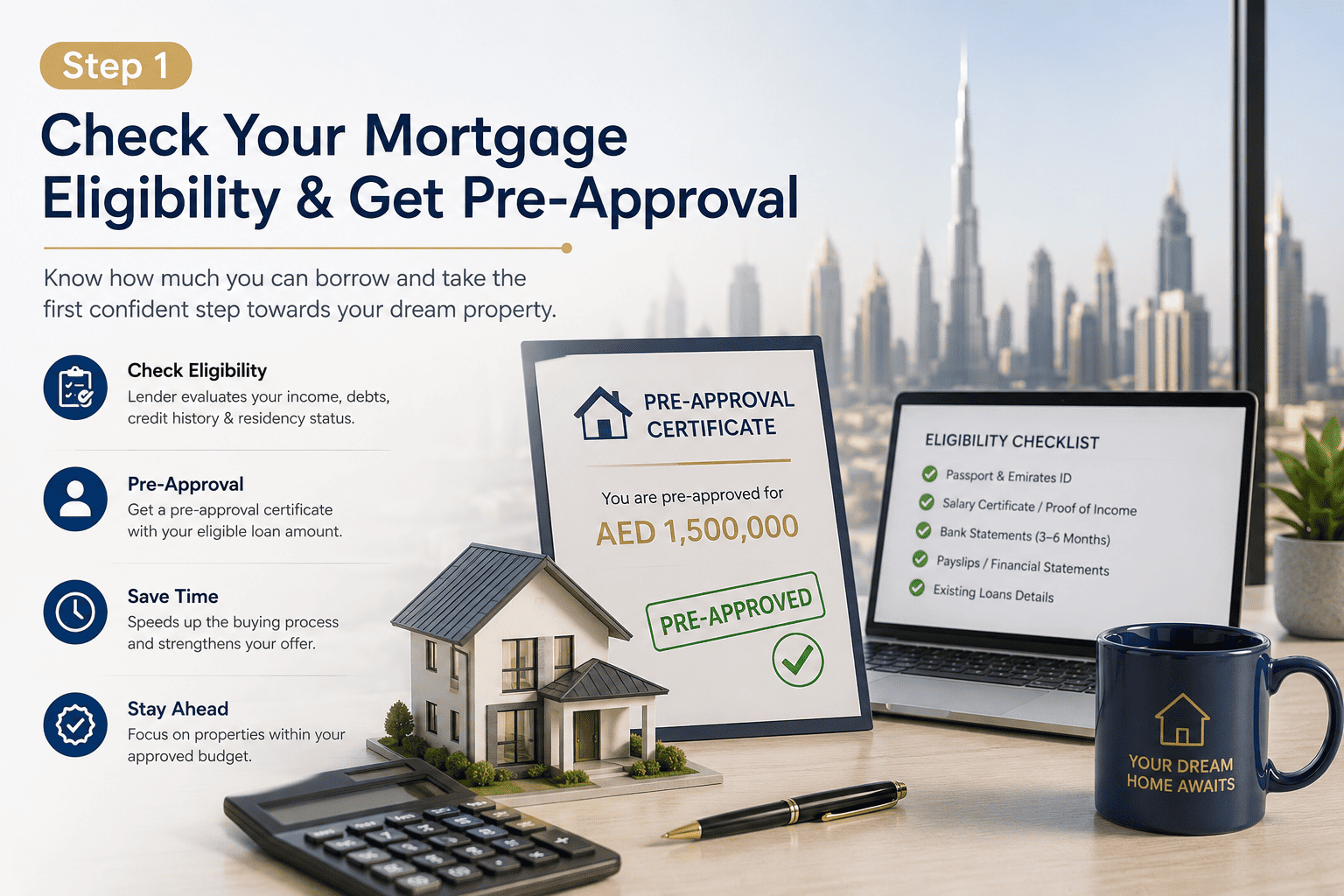
Step 1 Check Your Eligibility & Get Pre-Approval
Before you start viewing homes, you need to know two things: whether you qualify at all, and how much a UAE bank is actually willing to lend you.
The Central Bank of the UAE caps your total monthly debt commitments including your future mortgage payment at 50% of your gross monthly income (the Debt Burden Ratio, or DBR). Most lenders require a minimum salary of AED 15,000 to AED 25,000 per month for expats, and lower thresholds for UAE nationals depending on the bank.
Pre-approval typically takes 3–10 working days once your documents are in order and is valid for 60–90 days.
What you'll learn in Step 1:
- Who can apply and the LTV limits by residency status
- How lenders assess your income, employment, and credit history
- Exact documents needed salaried, self-employed, and non-resident
- How Debt Burden Ratio (DBR) is calculated with a worked example
- Why pre-approval matters and how to avoid common rejection triggers
→ Read Step 1: Check Your Eligibility & Get Pre-Approval
Step 2 Choose Your Mortgage & Find a Property
Once you know your budget, the next decision is the mortgage product itself. UAE lenders offer three main structures:
- Fixed-rate mortgages rate locked for 1 to 5 years. Typical Q1 2026 rates: 3.99% – 4.5%.
- Variable-rate mortgages track the Emirates Interbank Offered Rate (EIBOR) plus a bank margin. Typical range: 4% – 6%.
- Islamic home finance Sharia-compliant Ijarah or Murabaha structures, offered by ADIB, DIB, Emirates Islamic, and others.
The lowest headline rate is often not the cheapest mortgage over the life of the loan. Processing fees, valuation fees, insurance requirements, salary-transfer conditions, and early settlement rules all affect the total cost.
What you'll learn in Step 2:
- Fixed vs variable vs Islamic how each actually works
- The complete list of fees you'll pay (with real AED figures)
- Whether the UAE Golden Visa applies to your purchase
- How to compare mortgage offers side-by-side
- What to include in your initial sale contract (Form F in Dubai)
→ Read Step 2: Choose the Right Mortgage & Find Your Property
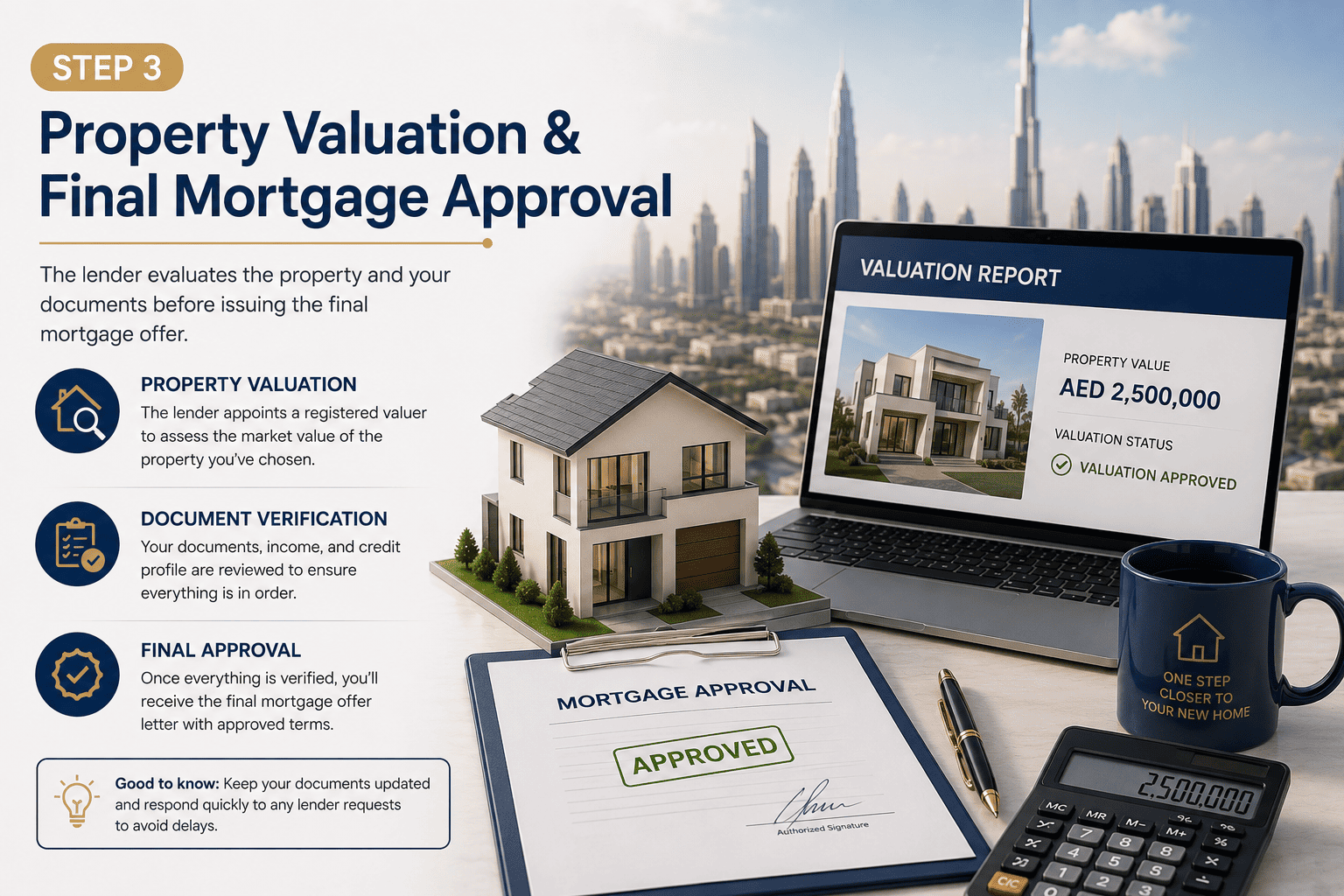
Step 3 Property Valuation & Final Approval
Before the bank releases the money, it needs to verify the property is worth what you agreed to pay. This is done by an independent, DLD-approved valuer appointed by the lender not the buyer, seller or agent.
Valuations typically cost AED 2,500 to AED 3,500 and take 3–5 working days. If the valuation comes in below the agreed purchase price which happens more often than buyers expect in a fast-moving market the bank will only lend against the lower figure, and you'll need to cover the shortfall in cash or renegotiate with the seller.
What you'll learn in Step 3:
- What the valuer actually inspects
- What to do if the valuation comes in low
- Every item on a Mortgage Offer Letter and what to check
- Property and life insurance requirements
- Financial mistakes that can revoke your final approval
→ Read Step 3: Property Valuation & Final Mortgage Approval
Step 4 Property Transfer & Handover
Transfer day is when ownership legally changes hands. In Dubai, this happens at a DLD-authorised Registration Trustee Office; in Abu Dhabi, at the Municipality; in other emirates, at the relevant land department.
You'll pay the 4% DLD transfer fee, the 0.25% mortgage registration fee, and the trustee office fee (typically AED 4,000 – 4,200). The lender's cheque settles the balance with the seller, or with the seller's existing bank if there's an outstanding mortgage to be bought out.
What you'll learn in Step 4:
- Everything that must be ready before you set foot in the Trustee Office
- The complete transfer day sequence documents, funds, keys
- How mortgage registration works and why it is required
- Managing your mortgage after handover
- Early settlement rules capped at 1% of outstanding balance or AED 10,000, whichever is lower (per CBUAE)
→ Read Step 4: Property Transfer, Handover & Becoming a Homeowner
What You'll Actually Pay Upfront
Buyers consistently underestimate the cash needed at closing. Here's a realistic breakdown for an AED 1.5 million secondary-market purchase in Dubai, with an expat resident borrowing 80%:
|
Cost item |
Amount (AED) |
Notes |
|
Down payment (20%) |
300,000 |
Minimum for expat resident, 1st property under AED 5M |
|
DLD transfer fee (4%) |
60,000 |
Buyer's portion; often split with seller by convention |
|
Mortgage registration (0.25%) |
3,000 |
Payable to Dubai Land Department |
|
Bank processing fee (1%) |
12,000 |
Typically, 0.5–1% of loan amount; often capped |
|
Property valuation |
2,500 – 3,500 |
Paid to the DLD-approved valuer |
|
Real estate agent commission (2%) |
30,000 |
Payable to the buyer's agent |
|
Trustee office fee |
4,000 – 4,200 |
Paid on transfer day |
|
Life & property insurance (year 1) |
3,000 – 8,000 |
Varies by borrower profile and property |
|
Total upfront cash needed |
AED 415,000 |
Approx. 27–28% of purchase price |
For a mortgage-only breakdown (excluding down payment), plan for 6–7% of the purchase price in fees, taxes, and insurance.
Who Can Get a Mortgage in the UAE?
Under Central Bank of the UAE Circular 31/2013 (as amended), the maximum you can borrow depends on your residency status and the property value:
|
Buyer type |
1st property < AED 5M |
1st property > AED 5M |
2nd / investment |
|
UAE National |
85% LTV |
75% LTV |
65% LTV |
|
Expat resident |
80% LTV |
70% LTV |
60% LTV |
|
Non-resident |
50–65% LTV |
50–65% LTV |
Case-by-case |
|
Off-plan (any buyer) |
50% max |
50% max |
50% max |
Non-residents can only buy in designated freehold zones which includes most of Dubai's major residential communities (Dubai Marina, Downtown, Palm Jumeirah, Business Bay, JVC, and dozens of others). Individual banks may apply stricter LTV limits than the CBUAE cap, but never higher.
Additional CBUAE rules to know:
- Maximum mortgage tenure: 25 years for residential property.
- Maximum age at loan maturity: 65 for salaried expats, 70 for UAE nationals and self-employed borrowers. Bank-set since the 2018 amendment.
- Debt Burden Ratio: 50% of gross monthly income (all commitments combined).
Quick note: LTV caps are regulatory maximums. In practice, individual banks may lend at lower ratios based on your risk profile, employer, or the property location. A broker can flag which lenders are most flexible for your specific situation.
How Long Does the Whole Process Take?
For a straightforward secondary-market purchase where documents are ready and the buyer's finances stay stable:
- Pre-approval 3 to 10 working days
- Property search & offer depends entirely on you (some clients take a weekend; others take six months)
- Final approval after signing 1 to 3 weeks
- Transfer day at the Trustee Office 1 day
- Total, from pre-approval to keys: 4 to 8 weeks typically
Off-plan purchases follow a different timeline governed by the developer's payment schedule; mortgage financing usually kicks in near or after completion.
Frequently Asked Questions
How long does the mortgage process take in the UAE?
For a secondary-market purchase, expect 4 to 8 weeks from pre-approval to receiving your keys. Pre-approval typically takes 3 to 10 working days, final approval another 1 to 3 weeks after signing the sale contract, and the transfer itself is usually completed in a single day at the DLD-authorised Trustee Office.
Can non-residents get a mortgage in Dubai?
Yes. UAE-licensed banks offer mortgages to non-residents in designated freehold zones, typically at 50 to 65 percent LTV. You'll need to provide overseas proof of income, bank statements, and often a personal UAE bank account. A handful of banks specialise in non-resident mortgages, and a broker can shortcut the process considerably.
What is the minimum salary required for a UAE mortgage?
Most UAE banks require a gross monthly income of AED 15,000 to AED 25,000 for expat residents, and AED 8,000 to AED 15,000 for UAE nationals depending on the lender and the property price. Higher-value purchases naturally require higher qualifying incomes.
What is the Debt Burden Ratio (DBR) and how much can I take on?
The Central Bank of the UAE caps your total monthly debt payments including your future mortgage at 50 percent of your gross monthly income. This includes credit cards, personal loans, car loans, and any existing mortgages. If your existing commitments are already close to 50 percent, you'll need to reduce them before applying.
Can I get a mortgage on an off-plan property in the UAE?
Yes, but the Central Bank caps off-plan LTV at 50 percent, meaning you'll need at least a 50 percent down payment. Many buyers use developer payment plans during construction and take a mortgage on the completed property.
Am I eligible for the UAE Golden Visa if my property is mortgaged?
Yes. Property purchases of AED 2 million or more can qualify you for a 10-year Golden Visa, even if financed by a mortgage provided you have paid at least AED 2 million in equity (typically evidenced by the down payment plus repaid principal). Always confirm current thresholds with the ICP or a qualified adviser before relying on them.
Do I need a mortgage broker or can I go directly to a bank?
Both are valid routes. A broker gives you access to multiple lenders' offers in a single process and is typically compensated by the bank rather than the borrower, so there's no fee to the buyer at most UAE brokerages. Going direct works well if you already bank with a lender that offers competitive rates and if you have time to negotiate.
Is mortgage pre-approval free in the UAE?
In most cases, yes pre-approval itself is offered without charge by most UAE lenders and by all reputable brokers. Fees are only charged once you accept a Mortgage Offer Letter and move to final approval, at which point the processing fee, valuation fee, and other lender charges apply.
Ready to Start Your UAE Mortgage Journey?
Every mortgage story is different your income structure, residency status, target emirate and property type all shape which lender and product actually work best. Off-the-shelf guidance only takes you so far.
At ClearRate, we work with every major UAE mortgage lender and can match you to the right product in a single conversation. There's no fee to you we're compensated by the lender when your mortgage completes.
💬 Chat with a mortgage expert on WhatsApp instant response during UAE business hours
📞 Call us on +971 545812998
🧮 Try our free UAE mortgage calculator
Disclaimer: All regulatory figures in this guide (LTV caps, DBR ceiling, mortgage tenure, early settlement fees) are based on Central Bank of the UAE Circular 31/2013 (as amended). Market rates and lender-specific fees are accurate to the best of our knowledge as of April 2026 but change frequently. This guide is general information and does not constitute financial or legal advice. Always confirm current requirements, rates and fees directly with your lender or a qualified UAE mortgage adviser before making a decision. ClearRate is a UAE-licensed mortgage brokerage.