
How UAE Banks Calculate Mortgage Affordability
When you apply for a mortgage in the UAE, the bank isn't just looking at the property price and your salary. It runs a structured assessment against a set of regulatory limits and internal risk criteria to decide exactly how much it's willing to lend. Understanding this process demystifies why two applicants with similar salaries can be offered very different loan amounts.
TL;DR
- Banks assess affordability primarily through your Debt Burden Ratio (DBR), capped at 50% of gross monthly income for expats and 60% for UAE nationals.
- Your Loan-to-Value (LTV) ratio is assessed alongside affordability, since both jointly determine your maximum loan amount.
- Banks verify income through salary certificates, bank statements, and salary-transfer status, weighting each differently.
- Your credit history with the Al Etihad Credit Bureau (AECB) feeds directly into both approval and pricing.
- Employment type salaried versus self-employed changes the documentation required and, often, the assessment approach.
- The bank's assessment is designed to protect both the lender and the borrower from over-leveraging.
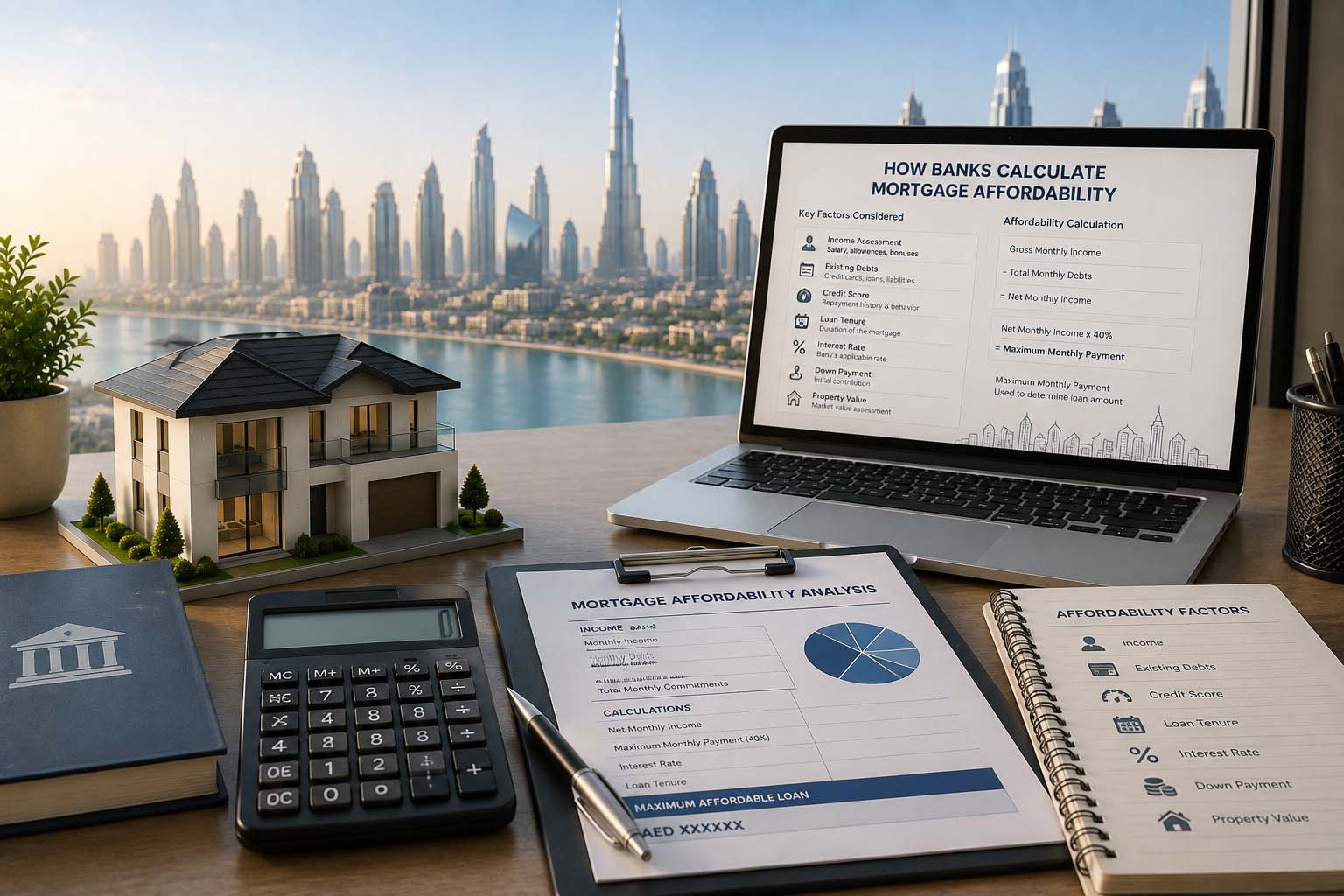
The Regulatory Framework Behind Every Assessment
Every bank operating in the UAE follows the lending standards set by the Central Bank of the UAE (CBUAE). These rules exist specifically to prevent excessive borrowing and protect the stability of the property market, and they apply uniformly regardless of which bank you approach.
Debt Burden Ratio (DBR): The Core Affordability Test
The DBR measures your total monthly debt obligations including the proposed new mortgage payment, plus any existing personal loans, car loans, and minimum credit card repayments as a percentage of your gross monthly income. For expatriates, this is capped at 50%; for UAE nationals, 60%. If adding a new mortgage payment would push your total debt obligations above this threshold, the bank will either reduce the approved loan amount or decline the application outright.
Loan-to-Value (LTV): The Complementary Limit
Alongside DBR, banks apply LTV limits based on your residency status, the property's value, and whether it's a first or subsequent property. These two metrics work together: DBR determines how much monthly repayment you can sustain, while LTV determines how much of the property's value the bank is willing to finance in the first place.
How Banks Verify Your Income
Salaried Employees
Banks typically request a salary certificate from your employer, recent bank statements showing salary credits, and sometimes a labour contract. If you transfer your salary to the lending bank, this is usually viewed favourably, both for approval and pricing purposes.
Self-Employed Applicants
Self-employed borrowers face a more detailed review, often including audited company financials, trade licence copies, and a longer track record of business income commonly two years or more. Because business income can fluctuate, banks may apply a more conservative affordability assessment than they would for a salaried applicant with an equivalent income.
Non-Resident Applicants
Applicants living overseas typically need to provide international bank statements, overseas tax documentation, and a credit reference from their home country, in addition to standard UAE documentation, reflecting the bank's need to verify income and creditworthiness outside the local system.
The Role of Credit History
Your report from the Al Etihad Credit Bureau (AECB) plays a central role in the bank's decision. A clean history with no missed payments and reasonable credit utilisation supports both approval and better pricing. Existing defaults, late payments, or high outstanding balances on other credit products can reduce your approved loan amount or affect the rate you're offered, even if your income comfortably meets the DBR threshold.
Stress Testing and Buffer Assessments
Some banks apply an internal stress test to variable-rate applications, assessing whether you could still comfortably afford repayments if interest rates were to rise during the loan term. This is a prudent, additional layer some lenders apply beyond the baseline regulatory requirements, and it can mean your actual approved amount is more conservative than a simple DBR calculation alone would suggest.
Frequently Asked Questions
1. What is the single most important factor in a UAE bank's affordability assessment?
Your Debt Burden Ratio (DBR) is typically the central metric, since it directly caps how much of your income can go towards a new mortgage payment.
2. Does salary transfer really affect my approved loan amount?
It can. Salary-transfer customers are often viewed more favourably by banks, both in terms of approval and the pricing they're offered.
3. How far back do banks look at my credit history?
There's no fixed period, but banks typically review your full active credit history with the AECB, with particular attention to recent payment behaviour and current outstanding balances.
4. Are self-employed applicants assessed differently for affordability?
Yes. Self-employed borrowers usually need to provide more extensive documentation, including audited financials, and banks may apply a more conservative view of income stability.
5. Can I improve my affordability assessment before applying?
Yes — reducing existing debt, maintaining a clean credit history, and transferring your salary to the lending bank can all improve how a bank assesses your affordability.
6. Do banks always lend the maximum amount my DBR allows?
Not necessarily. Some banks apply additional internal buffers or stress tests, meaning your actual approved amount may be more conservative than the regulatory maximum.
Final Thoughts
UAE banks follow a structured, regulation-driven process to assess mortgage affordability, centred on your Debt Burden Ratio, loan-to-value eligibility, and credit history. Understanding how each element is weighted helps you prepare a stronger application and gives you a realistic sense of what to expect before you submit your documents.
Get a Clearer Picture Before You Apply
ClearRate's Affordability Calculator estimates your borrowing power using the same core principles UAE banks apply, so you know roughly where you stand before approaching a lender.
Message ClearRate on WhatsApp for guidance on preparing a strong mortgage application.