How Much House Can You Really Afford in the UAE?
It's tempting to start house-hunting based on what a property lists for, but the more useful question is what you can genuinely afford once income, existing debt, and upfront costs are all factored in. In the UAE, that figure is shaped by clear regulatory limits, not just personal preference.
TL;DR
- Affordability in the UAE is governed by two core limits: your Debt Burden Ratio (DBR), capped at 50% of gross monthly income for expats, and your loan-to-value (LTV) ratio.
- Beyond the mortgage itself, budget an additional 7%–10% of the property price for upfront transaction costs.
- Your down payment requirement varies significantly by residency status and property value — typically 20% minimum for resident expats on a first property.
- Real affordability also accounts for ongoing costs: service charges, insurance, and utility connections.
- A realistic affordability figure is usually lower than the maximum a bank is willing to lend comfort and headroom matter as much as approval.
The Two Numbers That Define Affordability
Debt Burden Ratio (DBR)
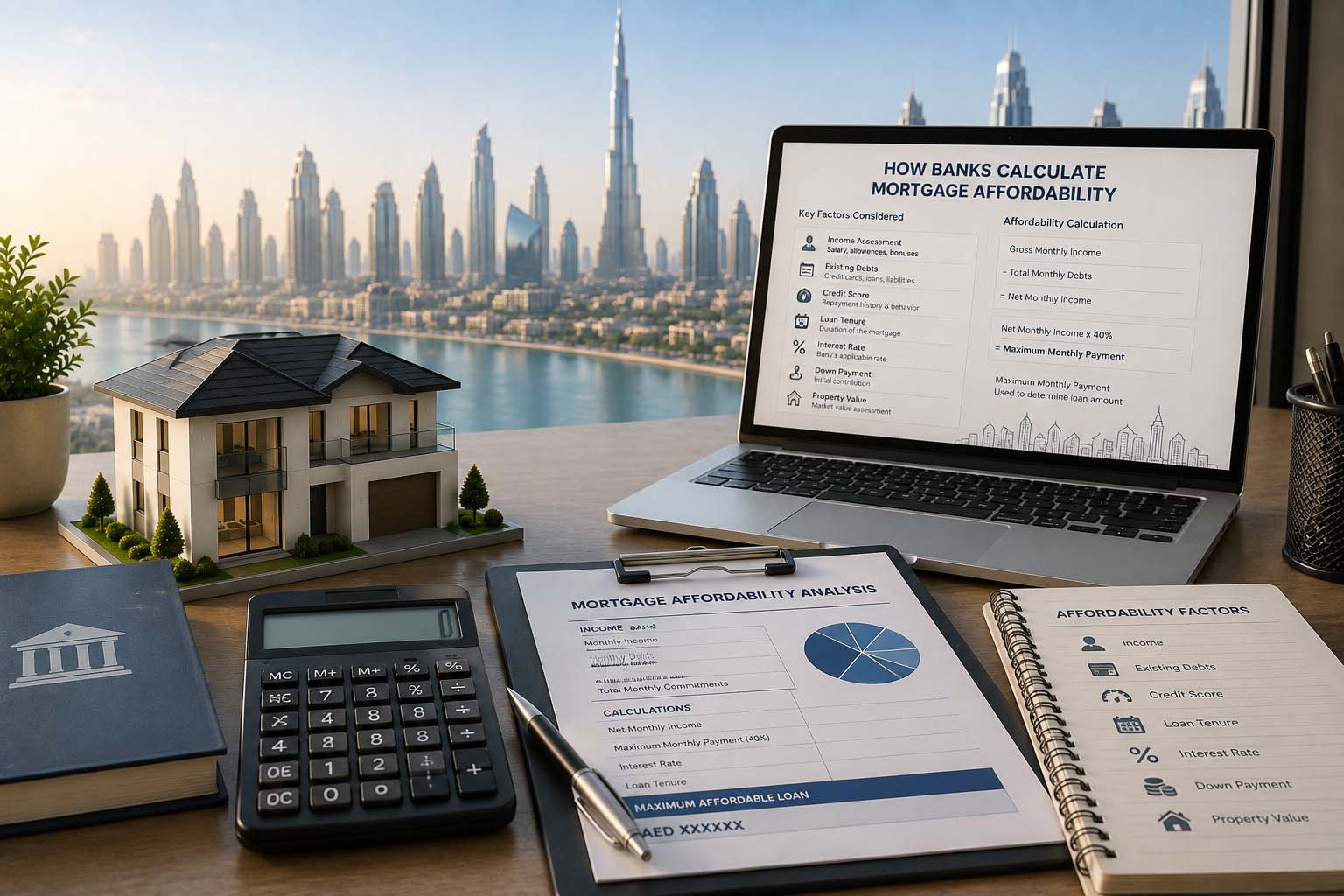
The Central Bank of the UAE requires banks to cap your total monthly debt repayments including your new mortgage plus any existing car loans, personal loans, or credit card minimums at 50% of your gross monthly income for expatriates (60% for UAE nationals). If your current obligations already use up a significant share of that allowance, your genuine mortgage affordability shrinks accordingly, even if your income looks strong on paper.
Loan-to-Value (LTV) Ratio
Your LTV determines your minimum down payment. Resident expats can typically borrow up to 80% on a first property valued at or below AED 5 million, dropping for higher-value properties, second homes, and off-plan units. Non-resident expats generally face a lower cap, often 50%–65%, requiring a larger cash contribution upfront. Whatever you don't borrow, you need in liquid savings before you can proceed.
Working Out Your Real Affordability
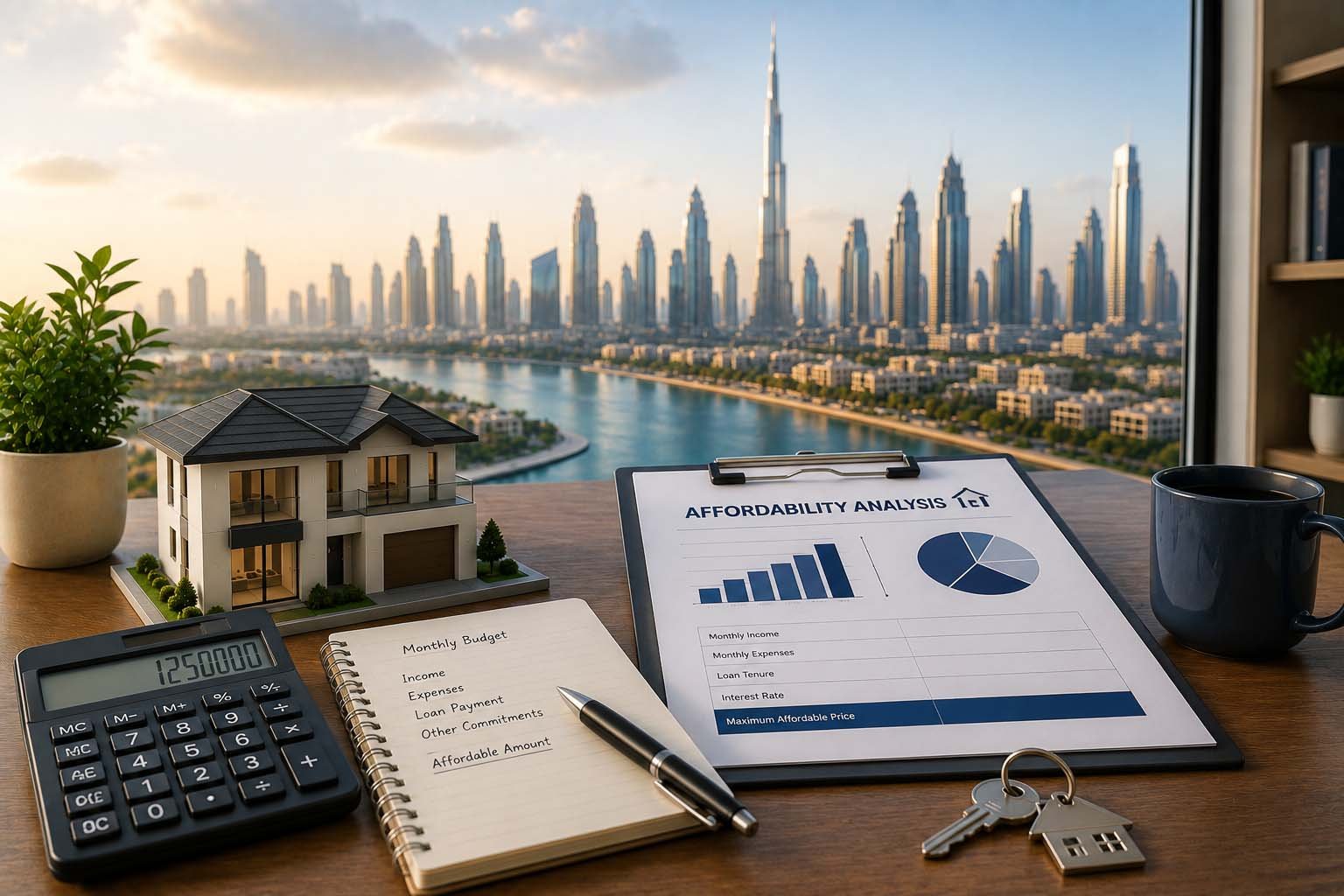
Step 1: Calculate Your Maximum Monthly Repayment
Take your gross monthly income, subtract your existing debt obligations, and apply the 50% DBR cap (for expats) to see how much monthly repayment capacity you actually have left for a mortgage.
Step 2: Translate That Into a Loan Amount
Using current UAE mortgage rates and your intended loan term, your maximum monthly repayment capacity translates into a maximum loan amount. A mortgage calculator does this conversion instantly, factoring in your chosen rate and tenure.
Step 3: Add Your Down Payment
Combine your maximum loan amount with the down payment your LTV bracket requires to arrive at your maximum property price. Remember that a larger deposit not only unlocks a higher LTV in some cases but also reduces your monthly repayment directly.
Step 4: Factor In Upfront Transaction Costs
Beyond the down payment, budget a further 7%–10% of the property price for land department transfer fees, agency commission (where applicable), mortgage registration, valuation, and utility connection deposits. These costs are due at completion and cannot typically be financed as part of the mortgage itself.
Why "Maximum Approved" Isn't the Same as "Comfortably Affordable"
A bank's maximum approval reflects the ceiling of what regulations and your income allow not necessarily what's comfortable for your lifestyle. Many financial advisers suggest leaving headroom below your DBR cap to absorb rate increases (if you choose a variable mortgage), unexpected expenses, or a change in income. Borrowing to the maximum approved amount leaves little buffer if circumstances change.
Frequently Asked Questions
1. What is the maximum percentage of my income that can go towards a mortgage in the UAE?
The Central Bank caps total monthly debt repayments, including your mortgage, at 50% of gross monthly income for expats and 60% for UAE nationals.
2. Does existing debt reduce how much mortgage I can afford?
Yes. Car loans, personal loans, and credit card minimums all count towards your Debt Burden Ratio, reducing the capacity left for a mortgage repayment.
3. How much deposit do I need as an expat buying my first home?
Typically a minimum of 20% for a resident expat buying a first property under AED 5 million, though this rises for higher-value properties, second homes, and non-resident buyers.
4. Should I borrow the maximum amount a bank approves?
Not necessarily. Many buyers choose to borrow below their maximum approval to keep a financial buffer for rate changes or unexpected costs.
5. What other costs should I budget for beyond the down payment?
Plan for an additional 7%–10% of the property price to cover transfer fees, mortgage registration, valuation, agency commission where applicable, and utility connection deposits.
6. Is affordability different for non-resident buyers?
Yes. Non-residents generally face lower LTV limits and larger required down payments, along with more extensive income and credit documentation.
Final Thoughts
Real affordability in the UAE isn't just about what a bank is willing to lend it's the intersection of your Debt Burden Ratio, your LTV bracket, and the upfront costs you'll need in cash. Working through these numbers before you start viewing properties gives you a realistic, comfortable budget rather than a stretched one.
Find Your Realistic Budget
ClearRate's Affordability Calculator helps you estimate how much you can genuinely borrow based on your income, existing debt, and down payment, so you can shop with confidence.
Message ClearRate on WhatsApp to talk through your affordability results.