How to Open a UAE Bank Account as a Non-Resident
A step-by-step guide for overseas applicants: eligibility, documents, source-of-funds checks, and what to expect If you don't hold UAE residency whether you're an overseas property investor, a remote worker considering a future move, or simply someone who wants a UAE account for savings or international transfers you can still open a personal bank account in the UAE. The process is real and works, but it follows a different path from resident account opening: fewer banks accept non-resident applicants, the account types available are narrower, and banks apply closer scrutiny to where your money comes from. This guide walks through exactly how the non-resident account opening process works, step by step what to prepare before you apply, what happens if you can't travel to the UAE in person, and how to avoid the most common reasons non-resident applications stall or get declined.
TL;DR
UAE Bank Account as a Non-Resident
✓Non-residents can open UAE bank accounts, but typically only savings or fixed deposit accountsnot full current accounts with cheque books or overdrafts.
✓Most banks that accept non-resident applicants require an in-person branch visit for identity verification; fully remote opening is available at only a small number of banks.
✓Source-of-funds documentation is the most heavily scrutinised part of a non-resident application prepare this thoroughly before applying.
✓Not every UAE bank accepts non-resident clients bank selection matters more for this group than for residents.
✓A registered Power of Attorney (POA) can let someone else complete the process on your behalf if you can't travel.
✓Expect the process to take longer than a resident applicationoften one to several weeks, depending on the bank and your documentation.
Am I Eligible to Open a UAE Bank Account as a Non-Resident?
In principle, most adult non-residents regardless of nationality can apply for a non-resident personal account at a UAE bank that offers this product. In practice, eligibility comes down to three things: whether the specific bank accepts non-resident applicants at all, whether you can meet its documentation and minimum balance requirements, and whether your profile clears the bank's own risk assessment.
Banks assess non-resident applications more cautiously than resident ones because they have less independent verification available no UAE residency status, no Emirates ID, and no local employer to confirm income. This doesn't mean approval is unlikely, but it does mean your documentation needs to do more of the work.
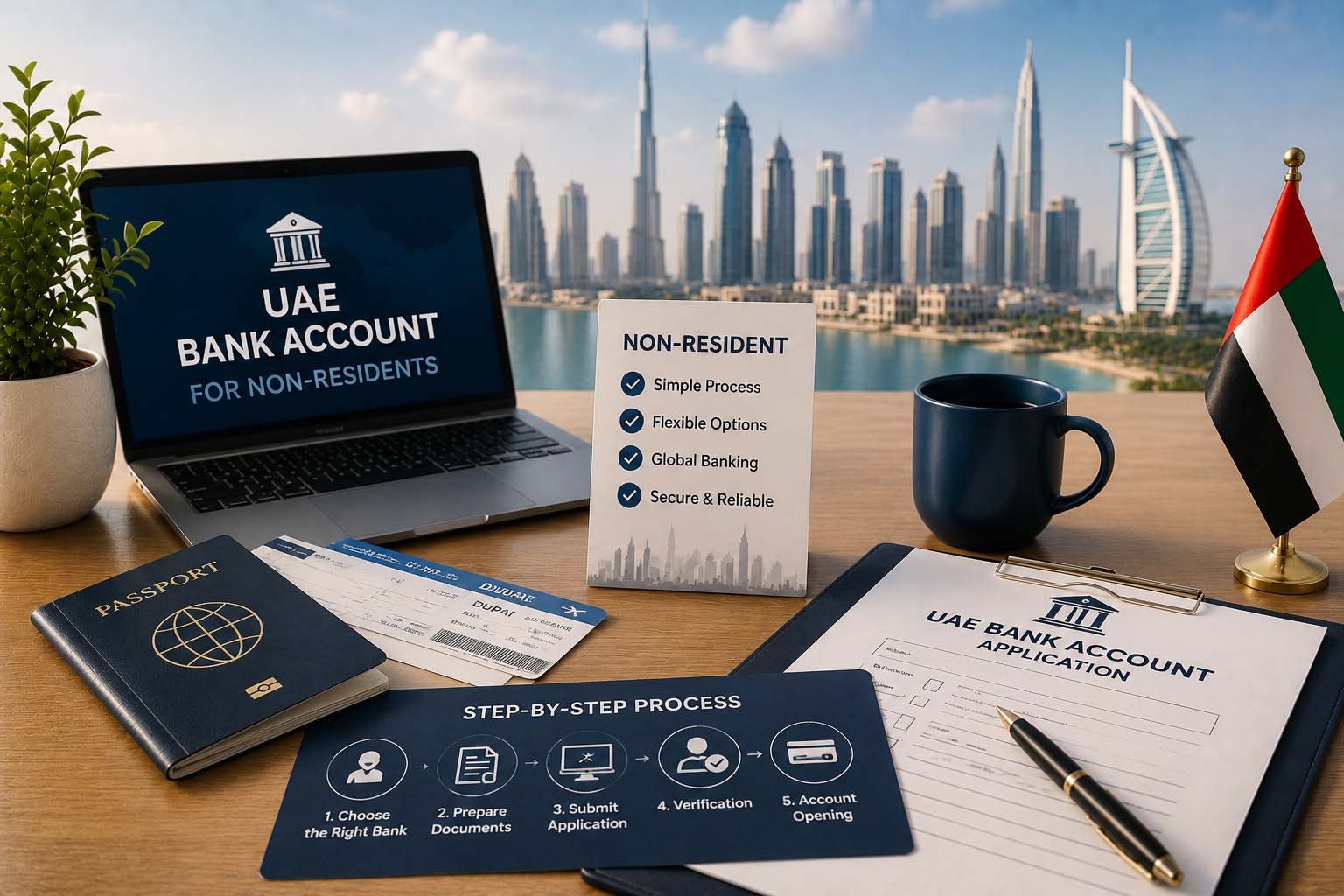
Step-by-Step: How Non-Residents Open a UAE Bank Account
1. Choose a Bank That Accepts Non-Resident Applicants
Not every UAE bank offers non-resident accounts, and policies differ in how strict or flexible they are. International banks with a presence in your home country sometimes offer a smoother path if you're already a customer of a bank that also operates in the UAE, ask whether an existing relationship can support your application.
2. Decide Which Account Type You Need
Most non-resident applicants are limited to a savings account or a fixed/term deposit account. If multi-currency support matters to you, confirm which currencies a specific bank's non-resident account actually supports, since this varies by bank.
3. Prepare Your Documentation in Full Before Applying
Incomplete documentation is the single biggest cause of delay for non-resident applications. See the full document list below and gather everything before you submit, rather than responding to requests piecemeal.
4. Submit Your Application
Depending on the bank, this may involve an online pre-application followed by an in-person branch visit, or in rarer cases a fully remote process. Confirm the exact steps directly with your chosen bank, since this differs meaningfully between institutions.
5. Complete Identity Verification
Most banks require in-person verification for non-resident applicants, though a small number offer video-call verification. If you cannot travel to the UAE, ask specifically whether your bank of choice supports remote verification or accepts a Power of Attorney (see below).
6. Respond to Compliance Follow-Up Requests
It's common for the bank's compliance team to come back with follow-up questions or requests for additional documentation, particularly around source of funds. Responding quickly and completely at this stage is one of the most effective ways to avoid unnecessary delay.
7. Fund and Activate Your Account
Once approved, you'll typically need to make an initial deposit to activate the account confirm the required opening amount with your bank in advance.
Documents Non-Residents Typically Need
Requirements vary by bank, but most non-resident applications ask for a combination of the following:
- Valid passport, with any UAE entry stamp if you've visited
- Proof of address in your home country a recent utility bill or official document
- A reference letter from your existing bank, confirming your banking relationship and standing
- Recent bank statements, typically the last three to six months
- An updated CV or professional background summary, in some cases
- Source-of-funds and, for larger deposits, source-of-wealth documentation
Some banks request additional documents for applicants they consider higher-risk based on nationality, country of residence, or occupation. This is a standard part of every bank's independent compliance process, not something specific to any one applicant.
Source-of-Funds Checks: What to Expect
Source-of-funds documentation is consistently the most scrutinised part of a non-resident application, and it's worth preparing this properly rather than treating it as an afterthought. Banks want to understand, with reasonable clarity, where the money you're depositing has come from salary, business income, property sale proceeds, investment returns, or inheritance, for example.
Useful supporting evidence commonly includes payslips or employment contracts, business financial statements, sale contracts or transaction records, or investment account statements, depending on the nature of the funds. The clearer and more consistent your documentation, the smoother this stage of the process tends to be. Vague or inconsistent explanations are a common reason applications stall at the compliance review stage.
Can I Open an Account Without Travelling to the UAE?
At most banks, no in-person verification remains the standard requirement for non-resident accounts. There are two possible workarounds, though neither is universally available:
- A small number of banks, often those where you already hold an account relationship in another country, may support remote or video-call verification for non-resident accounts
- A registered Power of Attorney (POA) can authorise someone else often a relative, business partner, or a professional advisor to complete the application and sign documents on your behalf. If the POA is issued outside the UAE, it typically needs to be attested and legalised for use in the country
Confirm directly with your chosen bank whether either option is supported before assuming you can complete the process without travelling.
What Non-Resident Accounts Typically Don't Include
It's worth setting realistic expectations before you apply. Non-resident accounts commonly come with more limitations than resident accounts:
- No cheque book, and current accounts are rarely offered to non-residents
- Credit facilities loans, overdrafts, and credit cards are generally not available
- Minimum balance requirements are often higher than for resident accounts, and vary significantly by bank
- Some services (such as certain local payment methods) may be limited compared to a resident account
For a broader comparison of the account types and providers available to non-residents and expats including how they differ from a full resident banking relationship see our guide, UAE Bank Accounts for Expats and Non-Residents: Options & Requirements
Frequently Asked Questions
1. Can a non-UAE resident open a bank account in the UAE?
Yes. Many UAE banks accept non-resident applicants, though typically only for savings or fixed deposit accounts, and with more documentation than a resident application requires.
2. Do I need to visit the UAE in person to open an account as a non-resident?
In most cases, yes in-person verification is the standard requirement. A small number of banks support remote verification, and a registered Power of Attorney can allow someone else to complete the process on your behalf.
3. What is the minimum deposit for a non-resident UAE bank account?
This varies significantly by bank and account type, with no single figure applying across the market. Non-resident minimum balances are often higher than resident accounts. Confirm the current requirement directly with your chosen bank.
4. How long does it take for a non-resident to open a UAE bank account?
Non-resident applications typically take longer than resident applications often one to several weeks due to additional compliance checks. Complete, well-prepared documentation is the biggest factor in reducing delay.
5. Can I open a UAE bank account remotely without ever visiting?
At most banks, no. A small number offer remote or video-call verification for non-residents, often only where you already hold a relationship with that bank elsewhere. Confirm this specifically before assuming it's available.
6. What documents prove source of funds for a non-resident account?
Commonly accepted evidence includes payslips or employment contracts, business financial statements, property sale contracts, or investment statements whatever accurately documents where the deposited funds came from.
7. Can non-residents get a debit card or online banking with a UAE account?
Many non-resident savings accounts do include a debit card and online/mobile banking access, though the exact features vary by bank. Cheque books and credit facilities are generally not included.
8. Can I use a Power of Attorney to open a UAE bank account for someone else?
Yes, provided the POA is properly registered and specifically authorises this. If issued outside the UAE, it typically needs to be attested and legalised for use in the country confirm the exact requirements with your chosen bank.
9. Are all UAE banks the same for non-resident applicants?
No policies differ significantly. Some banks don't accept non-resident applicants at all, while others actively offer non-resident products. This is why bank selection matters more for non-residents than for UAE-resident applicants.
10. Can ClearRate help me open a UAE bank account as a non-resident?
YesClearRate's Personal Bank Account Opening service helps non-residents identify banks suited to their profile and prepare a complete, well-documented application. We can't guarantee approval, since that decision always rests with the bank's own compliance process.
Related Guides
- How to Open a Personal Bank Account in the UAE: Complete Guide
- UAE Bank Account Requirements for Residents: Documents, Salary &Eligibility
- UAE Bank Accounts for Expats and Non-Residents: Options &Requirements
Official Resources
|
Ready to Open a UAE Bank Account as a Non-Resident? ClearRate's Personal Bank Account Opening service helps non-residents identify UAE banks realistically suited to their profile, and prepare the documentation including source-of-funds evidence that compliance teams expect to see. We can't guarantee approval, but we can help you apply well-prepared. |