UAE Mortgage Interest Rates in 2026: What Every Homebuyer Should Know
Interest rates shape almost every part of a mortgage decision from how much you can borrow to how much you'll pay over the life of the loan. If you're planning to buy property in the UAE this year, understanding where mortgage rates stand in 2026, and why they move the way they do, will help you budget accurately and negotiate with confidence.
TL;DR
- UAE mortgage rates in 2026 are priced either as a fixed rate for an initial period, or as a variable rate linked to EIBOR (Emirates Interbank Offered Rate).
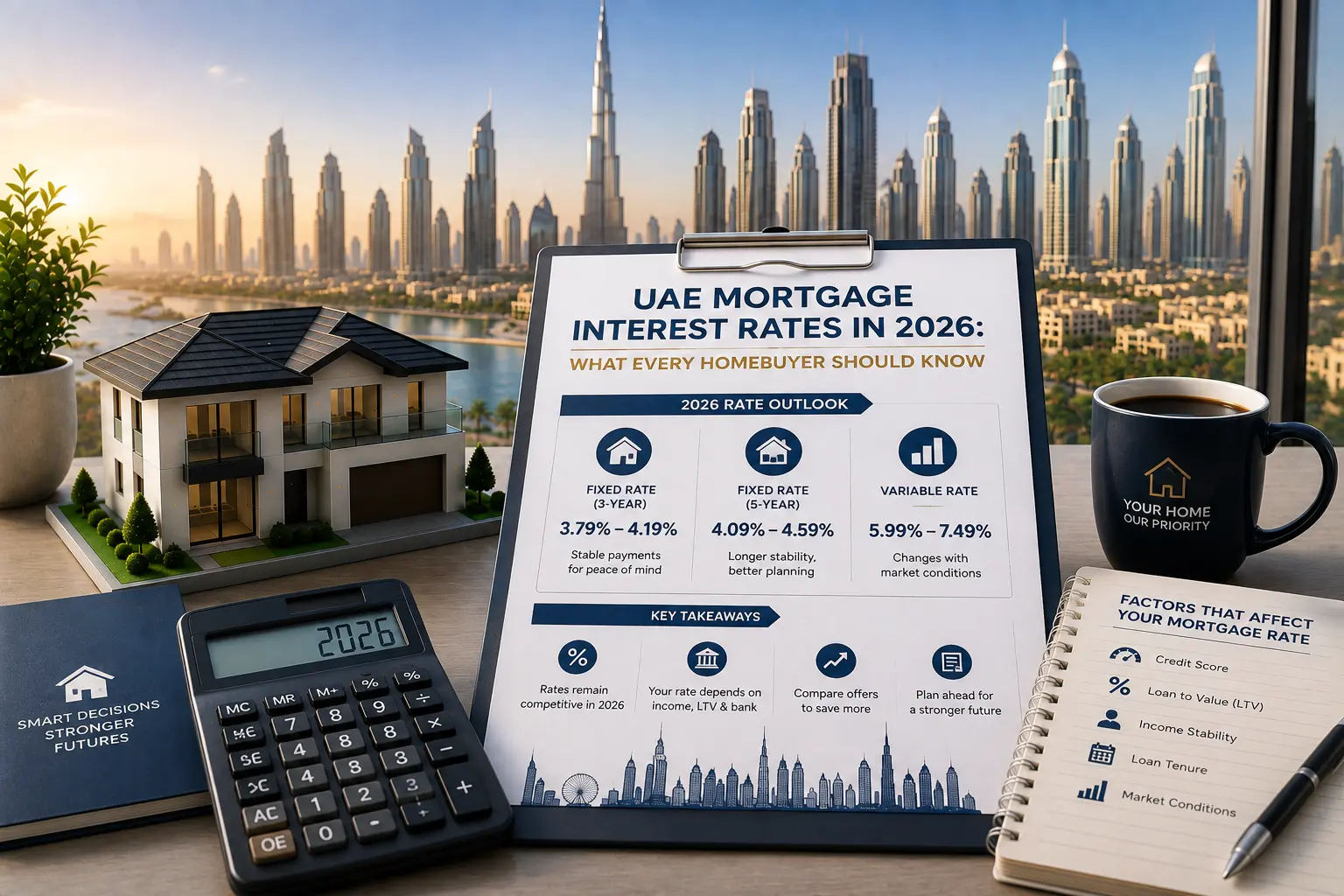
- Fixed rates currently start from roughly 3.75% to 4.75% per annum, depending on the lender, term, and whether your salary is transferred to the bank.
- Variable rates are quoted as EIBOR plus a bank margin, with all-in rates typically landing between 5.5% and 7%.
- Your rate depends on your income, loan-to-value (LTV) ratio, employment type, credit history, and salary-transfer status.
- Even a small rate difference has a large impact on total interest over a 20 –25-year term, so it's worth comparing offers rather than accepting the first one.
Understanding How UAE Mortgage Rates Work
Every mortgage rate in the UAE is anchored to one of two structures: fixed or variable. Both are regulated within the framework set by the Central Bank of the UAE (CBUAE), but the pricing itself is set competitively by individual banks.
The Role of EIBOR
EIBOR is the benchmark rate at which UAE banks lend to one another, published by the Central Bank. Because the UAE dirham is pegged to the US dollar, EIBOR tends to move in the same direction as US interest rate policy, with some local variation based on domestic liquidity. Most variable-rate mortgages are priced as EIBOR (often the 3-month rate) plus a fixed margin set by the bank for example, EIBOR + 1.5%. When EIBOR moves, your monthly instalment moves with it, recalculated at set intervals of one, three, six, or twelve months depending on your loan structure.
Fixed vs Variable Rates
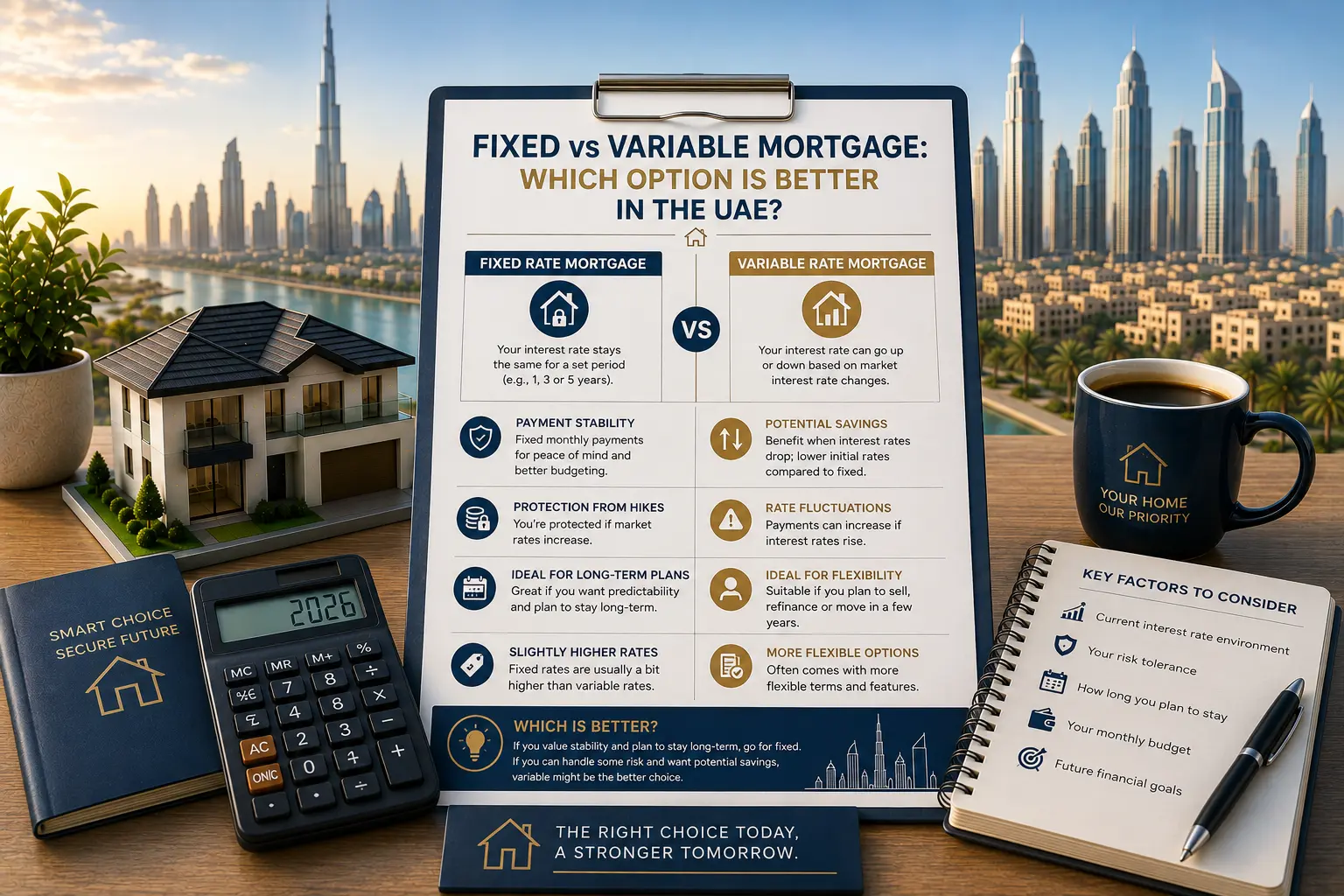
A fixed-rate mortgage locks your interest rate for an agreed period, typically one, two, three, or five years, after which it usually reverts to a variable rate linked to EIBOR. A variable-rate mortgage is tied to EIBOR from day one and adjusts throughout the loan term. Each has a different risk profile, which we cover in detail in a separate guide on fixed versus variable mortgages.
Current UAE Mortgage Rate Ranges in 2026
As of mid-2026, indicative pricing across major UAE banks looks like this:
- Fixed rates: approximately 3.75%–4.75% per annum for 1 to 5-year fixed terms, with shorter terms generally priced lower than longer ones.
- Variable rates: EIBOR plus a margin of roughly 1%–3%, producing an effective rate in the region of 5.5%–7%.
- Non-resident and self-employed borrowers typically see a slightly higher starting rate than salaried, salary-transfer residents, reflecting the additional risk assessment involved.
These figures are indicative only. Actual rates are set at each bank's discretion and change with market conditions, so always request an up-to-date rate card before making decisions.
What Influences the Rate You're Offered
Several factors determine where you land within these ranges:
- Salary transfer: Borrowers who transfer their salary to the lending bank are usually offered preferential pricing.
- Loan-to-value (LTV) ratio: A lower LTV (larger down payment) often unlocks a better rate.
- Employment type: Salaried employees at established companies typically receive more favourable terms than self-employed applicants, who face additional documentation requirements.
- Credit history: A clean record with the Al Etihad Credit Bureau (AECB) strengthens your negotiating position.
- Property type: Ready properties are generally priced more competitively than off-plan units, which carry additional lending restrictions.
How to Secure the Best Rate
Banks periodically adjust pricing to meet internal targets and published "starting rates" are not always what a given applicant will actually receive. It's worth obtaining quotes from several lenders, being transparent about your financial profile from the outset, and asking specifically whether salary transfer, longer relationships, or bundled products (such as life insurance) can improve your offer.
Frequently Asked Questions
1. What is EIBOR and why does it matter for my mortgage?
EIBOR is the Emirates Interbank Offered Rate, the benchmark UAE banks use to lend to each other. Variable-rate mortgages are priced as EIBOR plus a margin, so when EIBOR changes, your repayment changes too.
2. Is a fixed or variable rate better in the UAE right now?
It depends on your risk appetite and how long you plan to hold the property. Fixed rates offer payment certainty for the initial term; variable rates can be cheaper or more expensive depending on how EIBOR moves.
3. Can I switch from a variable to a fixed rate later?
In many cases, yes, either with your existing bank or through refinancing with another lender, though early settlement or switching fees may apply.
4. Do non-residents pay higher mortgage rates in the UAE?
Non-resident and self-employed applicants often see a slightly higher starting rate than salaried residents with salary transfer, reflecting the bank's additional risk assessment.
5. How often does a variable rate change?
It's typically re-priced at intervals of one, three, six, or twelve months, based on the prevailing EIBOR rate at that point.
6. Where can I check the current EIBOR rate?
The Central Bank of the UAE publishes EIBOR rates on its official website, and most banks reference this when quoting variable-rate mortgages.
Final Thoughts
Mortgage rates in the UAE are competitive and negotiable, but they're also highly dependent on your individual profile. Understanding how fixed and variable pricing works and what levers you can pull to improve your offer puts you in a stronger position before you ever sit down with a bank.
Need Help Navigating Your Mortgage Options?
ClearRate.ae helps UAE homebuyers understand their financing options with clear, practical guidance no agent commissions, no pressure. Whether you're comparing fixed and variable rates or preparing for pre-approval, our team is here to help.
Get in touch with ClearRate on WhatsApp to discuss your mortgage options today.