Fixed vs Variable Mortgage: Which Option Is Better in the UAE?
One of the biggest decisions you'll make when financing a property in the UAE isn't which bank to choose, but which type of interest rate to accept: fixed or variable. Each comes with a different risk and reward profile, and the right choice depends on your financial situation and how long you plan to hold the property.
TL;DR
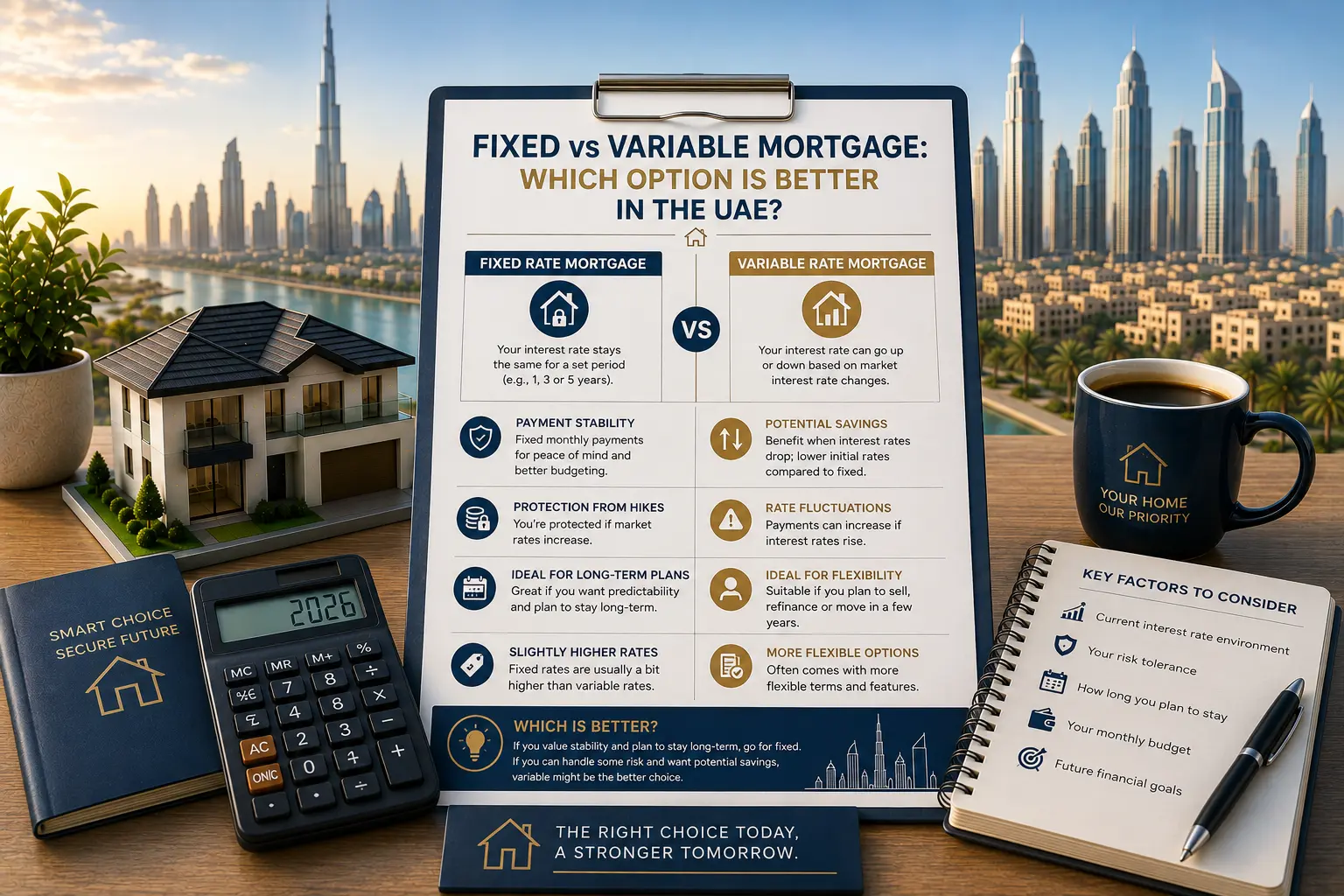
- Fixed-rate mortgages lock your interest rate for an initial period, typically 1 to 5 years, currently starting from roughly 3.75%–4.75% per annum.
- Variable-rate mortgages track the EIBOR benchmark plus a bank margin, producing effective rates generally in the 5.5%–7% range.
- Fixed rates offer payment certainty; variable rates offer potential savings if EIBOR falls, but exposure if it rises.
- Most fixed-rate deals revert to a variable rate once the fixed period ends.
- Your choice should reflect your risk tolerance, how long you intend to keep the property, and your view on where interest rates are heading.
How Fixed and Variable Rates Work in the UAE
Fixed-Rate Mortgages
A fixed-rate mortgage locks your interest rate for a set period, commonly one, two, three, or five years. During this time, your monthly instalment stays exactly the same, regardless of what happens to EIBOR or broader interest rate policy. Once the fixed period ends, the loan typically reverts to a variable rate linked to EIBOR plus the bank's standard margin, unless you refinance or negotiate a new fixed term.
Variable-Rate Mortgages
A variable-rate mortgage is priced as EIBOR plus a margin from day one, for example, 3-month EIBOR plus 1.5%. Because EIBOR is re-fixed at regular intervals typically every one, three, six, or twelve months, depending on your loan structure your monthly repayment can rise or fall as the benchmark moves. Since the UAE dirham is pegged to the US dollar, EIBOR generally tracks US interest rate policy, with some local liquidity-driven variation.
Comparing the Two: Key Considerations
Payment Certainty vs Flexibility
Fixed rates are the clear choice for buyers who value predictability, particularly those on a tight monthly budget or who prefer not to monitor interest rate movements. Variable rates suit buyers comfortable with some fluctuation in exchange for the possibility of paying less if rates ease.
Cost Over Time
On paper, fixed rates in the UAE currently start slightly lower than headline variable rates, but the real comparison depends on where EIBOR moves over your fixed term and what happens after it reverts. A small difference in rate compounds meaningfully over a 20–25 year mortgage, so it's worth modelling both scenarios rather than comparing headline rates alone.
How Long You Plan to Hold the Property
If you expect to sell or refinance within a few years, a shorter fixed term may offer the best of both worlds: rate certainty for your likely holding period, without locking in for the full loan term. If you're buying a long-term family home, a longer fixed period, or accepting variable exposure with a strong buffer in your budget, may suit better.
Early Settlement and Switching
Fixed-rate products often carry early settlement or switching fees if you repay the loan or move to another product before the fixed term ends. Variable-rate mortgages are generally more flexible in this regard, which matters if you anticipate an early sale, refinance, or lump-sum repayment.
Which Should You Choose?
There's no universally "better" option; it depends on your circumstances:
- Choose fixed if you want predictable monthly payments, plan to hold the property through the fixed period, and prefer not to track interest rate movements.
- Choose variable if you're comfortable with some payment fluctuation, believe rates may ease over your holding period, or want more flexibility to switch or settle early without penalty.
- Consider a hybrid approach, where available, combining an initial fixed period with a variable structure thereafter, to balance certainty and flexibility.
Frequently Asked Questions
1. What's the main difference between fixed and variable mortgages in the UAE?
A fixed-rate mortgage locks your interest rate for a set period, while a variable rate moves with EIBOR throughout the loan term.
2. Which is cheaper, fixed or variable?
It depends on where EIBOR moves over your loan term. Fixed rates currently start slightly lower, but variable rates could become cheaper if EIBOR falls, or more expensive if it rises.
3. Can I switch from variable to fixed later, or vice versa?
In many cases, yes, either with your current bank or by refinancing elsewhere, though switching or early settlement fees may apply.
4. What happens when my fixed-rate period ends?
The loan typically reverts to a variable rate linked to EIBOR plus the bank's standard margin, unless you renegotiate a new fixed term.
5. Is a variable rate riskier for first-time buyers?
It carries more payment uncertainty, since your instalment can change as EIBOR moves, so it suits buyers with more budget flexibility.
6. How often does a variable rate change in the UAE?
Typically, at intervals of one, three, six, or twelve months, based on the prevailing EIBOR rate for that period.
Final Thoughts
Choosing between a fixed and variable mortgage comes down to how much certainty you need versus how much flexibility and potential savings you're willing to trade for it. Both are viable, well-regulated options in the UAE the right one depends entirely on your financial situation and plans for the property.
Not Sure Which Mortgage Structure Is Right for You?
ClearRate.ae helps buyers weigh up fixed versus variable options clearly, based on their own circumstances, without agent pressure.
Message ClearRate on WhatsApp to talk through your options.