Can Expats Get a Mortgage in the UAE? Everything You Need to Know
The UAE is home to one of the most active expat property markets in the world, and yes, expatriates can absolutely get a mortgage here. But the rules for expats differ from those for UAE nationals, and understanding them upfront will save you time, false starts, and disappointment further down the line.
TL;DR
- Expats both residents and non-residents can obtain a mortgage in the UAE, subject to Central Bank of the UAE (CBUAE) regulations.
- Resident expats can typically borrow up to 80% loan-to-value (LTV) on a first property valued under AED 5 million.
- For properties above AED 5 million, or for a second property, the maximum LTV drops, generally to around 60%–65%.
- Non-resident expats face stricter limits, commonly capped between 50% and 65% LTV, meaning a larger cash down payment.
- Off-plan properties are capped at 50% LTV for every buyer type, regardless of residency status.
- Your Debt Burden Ratio (DBR) cannot exceed 50% of gross monthly income across all your existing debt obligations.
Mortgage Eligibility for Expats in the UAE
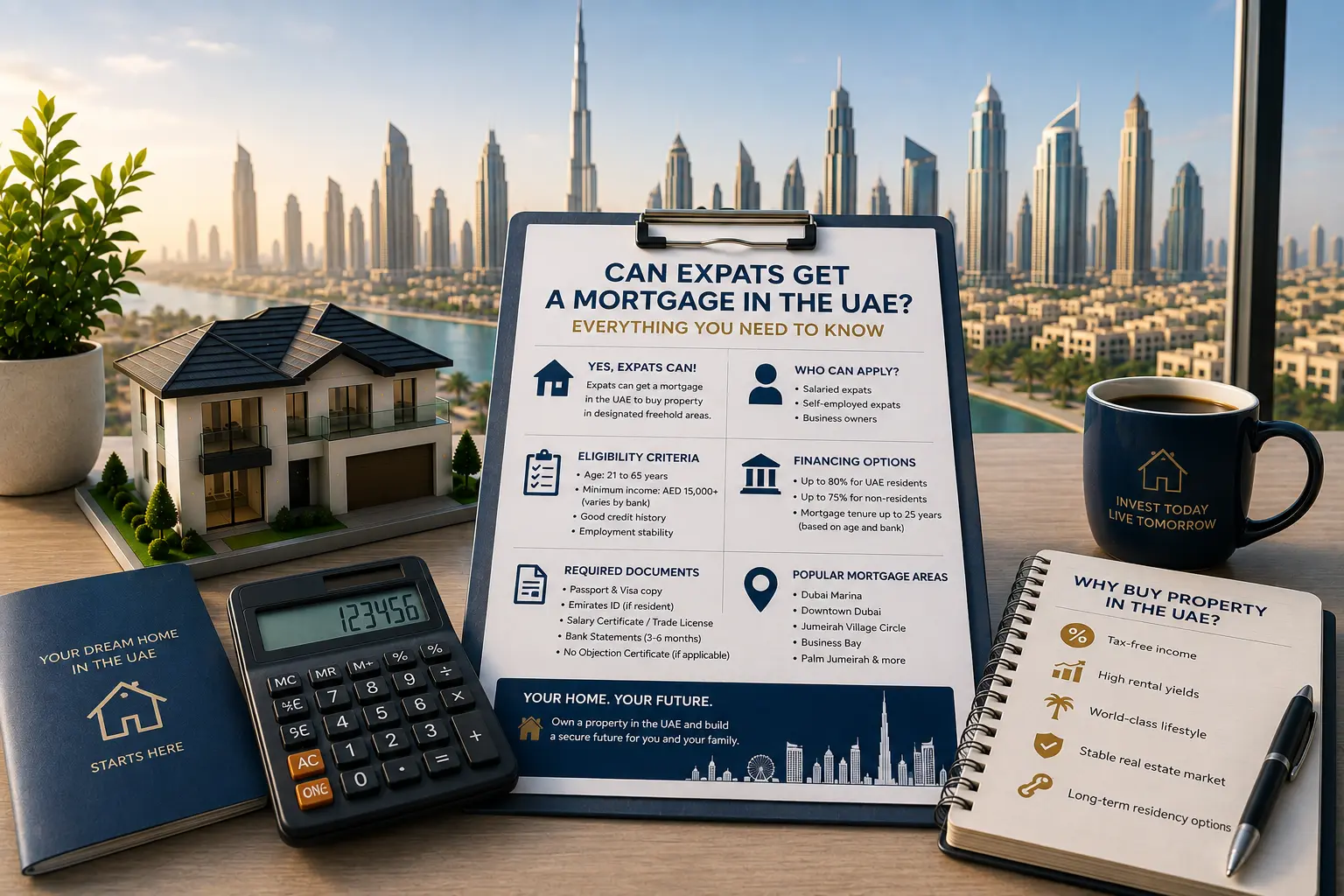
The Central Bank of the UAE regulates mortgage lending for every bank and financial institution operating in the country, and these rules apply uniformly regardless of which bank you approach. The key metric banks use is the Loan-to-Value (LTV) ratio: the percentage of the property's value the bank is willing to lend, with the remainder due as a down payment.
Resident Expats
If you hold a UAE residence visa and can demonstrate stable income, you're generally treated as a resident borrower. For a first property valued at AED 5 million or below, resident expats can typically borrow up to 80% of the property's value, meaning a minimum 20% down payment. Above that threshold, or for a second or investment property, the maximum LTV steps down, usually to the 60%–65% range.
Non-Resident Expats
If you live overseas and want to invest in UAE property without relocating, you'll usually face a more conservative LTV, typically between 50% and 65%, along with more extensive documentation requirements overseas bank statements, tax returns, and a credit report from your home country. Expect to bring a down payment of 40% or more.
Off-Plan Properties
Regardless of your residency status, off-plan (under-construction) properties are capped at a maximum of 50% LTV, reflecting the additional completion risk lenders take on with unfinished developments.
What Banks Look for Beyond LTV
Debt Burden Ratio (DBR)
Alongside LTV, banks assess your Debt Burden Ratio the proportion of your gross monthly income already committed to debt repayments, including personal loans, car finance, and credit card minimums. For expats, this is generally capped at 50% of gross monthly income. If you already carry significant debt, your mortgage eligibility will shrink accordingly.
Salary and Employment
Most banks require a minimum monthly salary, commonly in the AED 15,000–25,000 range, though this varies by lender. Salaried employees with salary transferred to the lending bank are typically viewed most favourably, while self-employed applicants face additional scrutiny of business financials.
Age and Tenure
The maximum mortgage tenure in the UAE is 25 years, with an age cap at loan maturity of around 65 for salaried employees and 70 for the self-employed. This means the younger you start, the longer your repayment term can potentially run.
The Application Process for Expats
1. Pre-approval: Submit your documents (passport, visa, salary certificate, bank statements) for an initial assessment, typically taking 3–7 business days.
2. Property selection and valuation: Once you've identified a property, the bank arranges an independent valuation.
3. Final approval: Following valuation and underwriting, final approval usually takes a further 5–10 business days.
4. Registration: The mortgage is registered with the relevant land department, a process that typically takes about a week.
From document submission to keys in hand, most expat buyers should budget four to eight weeks for a ready property.
Frequently Asked Questions
1. Do I need a UAE residence visa to get a mortgage?
No, but non-resident expats face stricter LTV limits and more extensive documentation than resident expats with a valid UAE visa.
2. What is the minimum down payment for an expat buying their first home?
For a resident expat buying a first property under AED 5 million, the minimum down payment is typically 20% of the property value.
3. Can self-employed expats get a mortgage in the UAE?
Yes, though banks will require additional documentation such as audited financials, trade licence copies, and a longer track record of business income.
4. Is it harder to get a mortgage for an off-plan property as an expat?
Financing rules are the same regardless of nationality for off-plan purchases all buyers face a maximum 50% LTV, and some banks prefer to lend only once the property nears handover.
5. Does my existing debt affect my mortgage eligibility?
Yes. Your Debt Burden Ratio, which includes all existing loans and credit obligations, cannot exceed 50% of your gross monthly income as an expat.
6. How long does the mortgage approval process take for expats?
Typically four to eight weeks from document submission to registration, assuming all paperwork is in order and the property valuation proceeds smoothly.
Final Thoughts
Getting a mortgage as an expat in the UAE is entirely achievable, and for many, more straightforward than in their home country. The key is understanding the LTV and DBR limits that apply to your specific situation before you start house-hunting, so you know exactly what you can afford and what documentation to prepare.
Thinking About Buying Property in the UAE?
ClearRate.ae connects buyers directly with verified property owners no agent commissions, no middlemen. If you'd like guidance on your mortgage options as an expat buyer, our team is ready to help.
Message ClearRate on WhatsApp to start the conversation.